
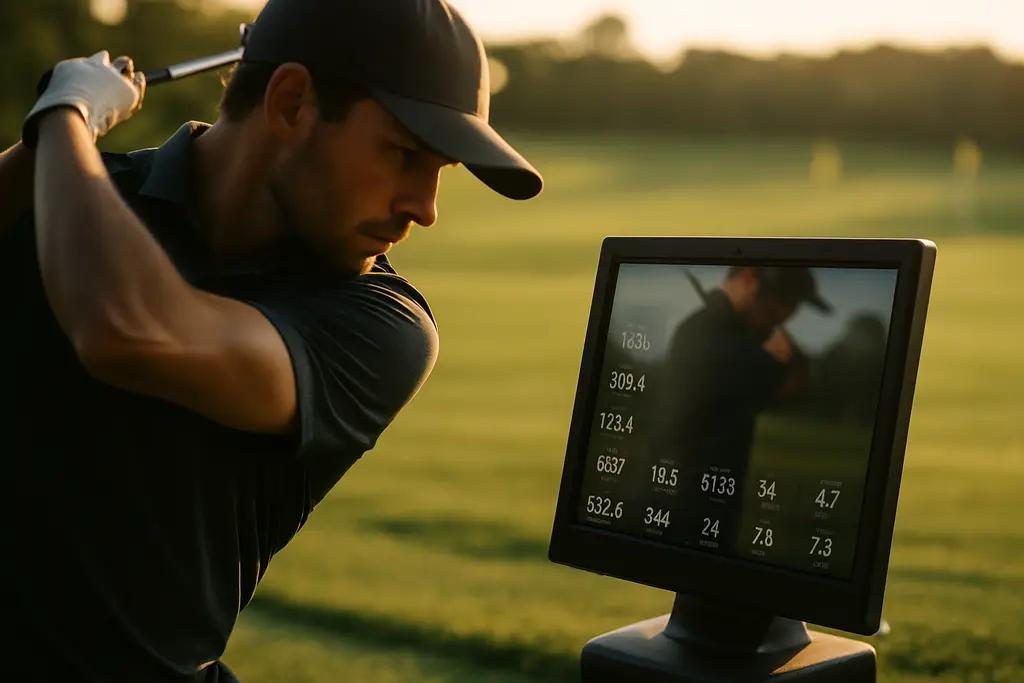
The Square Golf Omni arrived in a market that has moved quickly from tour-only launch monitor use to garage simulators, indoor fitting bays, and serious home practice. As of October 6, 2026, it is no longer just a preorder story: research notes indicate units are shipping after preorders opened on March 16, 2026, at a listed price of USD 1,599. The better question for a golfer is not whether it is cheaper than premium systems. It is whether the data, space needs, and ownership cost fit the way you actually practice and test clubs.
From a fitting perspective, budget launch monitors are valuable if they genuinely assist a player in making more informed decisions. Carry distance, ball speed, launch, spin, strike location, and shot pattern can all influence club choice. But those numbers need context. A launch monitor that works well in a 10-foot indoor setup may be a strong home option, while a radar unit may still be a better match for outdoor range work where full flight tracking is the priority.
Why Budget Launch Monitors Are Growing
Market Growth Is Real, But Data Quality Still Matters
The broader golf equipment market was valued at about USD 9.60 billion in 2025, with 206 million units sold globally, and launch monitors, rangefinders, and GPS devices were identified as the fastest-growing sub-category at 11.6% of total value, according to Douglas Insights. That growth tracks with what I see in fitting conversations: more golfers want numbers before buying equipment, and more players are trying to build practice setups at home.
The launch monitor category itself is still smaller than clubs or balls, but it is gaining weight. The global golf launch monitor market was valued at approximately USD 234.4 million in 2025, projected at USD 248.6 million in 2026, and forecasted to reach USD 523.5 million by 2035, according to GM Insights. That does not mean every lower-cost device is fitting-grade. It means buyers now have more choices, and the gap between a practice tool and a serious data tool needs careful sorting.
Why Price Is Only One Part Of Value
A budget launch monitor can look affordable on the first invoice and still cost more over time if core features sit behind a subscription. The supplied research notes state that the Omni has no subscription or paywall for its full feature set and includes GSPro compatibility. That matters for golfers building a home simulator because software access, club data, and ongoing fees can shift the real cost of ownership.
Still, a lower price does not remove the need for verification. If you are using a device for gapping, shaft comparisons, or driver loft settings, you need repeatable reads. A few odd shots are not a deal-breaker; every system can miss reads. The concern is whether the misses are predictable enough that you can separate a bad swing from a bad data point.
Square Golf Omni Data And Setup
Square Golf Omni Camera System
The Square Golf Omni is described in the research as a photometric launch monitor using four high-speed infrared cameras. It is built to measure ball and club data, including spin, launch angle, and impact location, and it does not require marked balls. That is a practical advantage indoors. Many golfers want to use their normal ball for wedge work, iron gapping, and driver testing rather than switching into a special marked-ball workflow.
Photometric systems read the ball and club around impact. That tends to suit indoor simulator rooms because the unit does not need the same long ball-flight window that radar devices often prefer. The research notes list the Omni’s approximate room need at 10 feet from tee to screen with about 9 feet of ceiling height. That can make the difference between a usable garage bay and a setup that never leaves the planning stage.
For golfers comparing indoor tech and room planning, a related look at home golf simulators is useful because the launch monitor is only one part of the setup. Mat quality, screen distance, enclosure depth, lighting, ceiling height, and safe swing clearance all affect whether the numbers you collect feel trustworthy.
Where The Reported Accuracy Fits A Fitting Session
The product research supplied for this article includes third-party testing that reported carry distance within a few yards, ball speed within plus or minus 1 mph, and spin within about 200 RPM when checked against high-end units such as Uneekor Eye XO and Foresight GC3. Those are useful reference points, but they should not be treated as a blanket guarantee for every room, shot type, lighting condition, or player.
In a fitting bay, I would treat those data categories differently. Ball speed and carry are helpful for confirming strike quality and general efficiency. Launch angle and spin help with driver loft, shaft profile, and iron descent. Impact location can be very valuable, especially for players testing length, lie, and face contact. But the research also notes that the impact-location sensor missed reads in about one in five shots during testing, especially on high-lofted clubs or mishits. That is not fatal for practice, but it matters for fitting. If impact location is missing on the exact shots you need to diagnose, you may still want a fitter’s strike spray, face tape, or a higher-end system as a check.
Who The Omni Fits Best
Indoor Golfers With Limited Space
The strongest case for the Square Golf Omni is an indoor golfer who wants meaningful data without building a long radar room. If your priority is hitting into a net or screen, checking carry gaps, working on start line, and testing equipment changes in the same space each week, the camera-based format makes sense. The no-subscription structure also helps golfers who dislike paying every year to keep features they already rely on.
That said, a good setup still needs discipline. You should level the hitting area, use consistent balls, avoid mixing range balls with premium balls during gapping, and keep a simple testing routine. Hit enough shots to spot trends. Remove obvious mishits from averages. Compare clubs by dispersion and launch windows, not one perfect swing. This is where budget launch monitors can help a golfer become less reactive and more organized.
Golfers Who Should Still Consider Radar
The main trade-off is outdoor ball flight. The research notes state that the Omni is usable both indoors and outdoors, but its photometric system reads the ball at impact rather than tracking full flight outdoors like radar. If most of your testing happens on a driving range, especially with longer clubs, radar or radar-camera hybrid units may still be a better fit. Full-flight observation can be valuable for curvature, wind response, and driver pattern work.
That does not make the Omni a poor product. It means the use case matters. A golfer building an indoor simulator has different needs than a coach running outdoor range sessions. A player who wants winter wedge practice in a garage has different needs than a tournament player validating driver windows downrange.
How I Would Use It In Club Testing
Good Uses For A Budget Launch Monitor
If I were using the Square Golf Omni in a fitting-first workflow, I would lean into repeatable indoor tests. It can be useful for comparing iron carry gaps, checking whether a driver head change alters launch and spin, and watching how contact changes with shaft length or swing weight. I would not treat one session as a purchase order. I would look for patterns over multiple sessions, especially for golfers whose swing speed or delivery changes from day to day.
- Driver work: Track launch, spin, ball speed, carry, and left-right pattern before changing loft or shaft.
- Iron gapping: Build carry windows with the same ball and enough shots to remove obvious mishits.
- Wedge practice: Use carry control and launch trends, while checking strike by eye if impact reads are missed.
- Home simulator play: Prioritize safe spacing, consistent setup, and stable lighting before judging the device.
One useful habit is to save or write down baseline numbers before making equipment changes. If your 7-iron carry, launch, spin, and descent pattern are known, you have a real reference point when testing a new shaft or loft setup. That is better than buying from a single high-ball-speed swing.
Where A Fitter Still Adds Value
A launch monitor gives numbers, but it does not always tell you which problem to solve first. A high-spin driver can come from strike, loft, shaft delivery, angle of attack, ball choice, or face-to-path relationship. A short iron gap can be a loft issue, a strike issue, or a set-makeup issue. A fitter can connect the numbers to the build: lie angle, length, shaft weight, grip size, head model, and set composition.
For golfers interested in how equipment data moves through the wider manufacturing and design chain, CAD/CAM technology coverage provides insightful context on how digital tools support product development. In the fitting bay, the same principle applies on a smaller scale: good data is only useful if it leads to a clear build decision.
Is The Square Golf Omni Worth It?
The Square Golf Omni looks most compelling for serious indoor golfers who want a camera-based launch monitor under USD 2,000, do not want ongoing feature fees, and have limited room depth. Its reported data performance, standard-ball use, and indoor-friendly spacing make it a strong option for home simulator work and structured practice.
I would be more cautious if your main goal is outdoor long-game testing. Because the system reads impact rather than full outdoor flight, radar or hybrid systems may offer better feedback on range sessions, especially for driver and fairway wood work. I would also avoid leaning too heavily on impact-location data alone if the missed-read rate appears during your own testing.
So, is it worth it? For the right golfer, yes: indoor space, simulator use, cost control, and practical club testing are the fit. For the wrong golfer, especially one who wants full-flight outdoor validation, it may not be the best first choice. The smart move is to match the monitor to your practice environment before matching it to your budget.