

Takomo Lumo putters marked a clear new category for the direct-to-consumer iron brand when the Lumo M1 mallet and Lumo B1 blade launched on October 6, 2026. For fitters, the useful story is not just that Takomo entered putting. It is that both heads arrived with a single-bend low-torque shaft design, fixed core specs, and two head shapes aimed at different setup preferences.
That makes the Lumo line easy to talk about in a fitting bay, but not automatic to prescribe. Low-torque putters can change how the face feels through the stroke, and golfers react differently to onset, head size, alignment shape, and shaft entry. The right question is not whether the M1 or B1 is better. The right question is which one helps a player aim, start the ball, control speed, and repeat contact under normal playing pressure.
Takomo Lumo putters At A Glance
Launch Date And Design Source
Takomo officially entered the putter market with the Lumo M1 and Lumo B1 on October 6, 2026, as reported by GOLF.com. The same report said the single-bend low-torque shaft concept came from Takomo’s December 2025 purchase of Finnish putter brand Otso Golf, including designer Miikka Farin.
From a fitting standpoint, that background matters because this is not a decorative release built around paint and stamping. The defining design choice is the relationship between shaft entry, head geometry, and torque reduction. A golfer who has always used a plumber’s neck blade may see the head sit and swing differently. A player already comfortable with face-balanced mallets may find the transition easier, but the fitting still needs to confirm aim and distance control.
Takomo Lumo putters Specs That Affect Fit
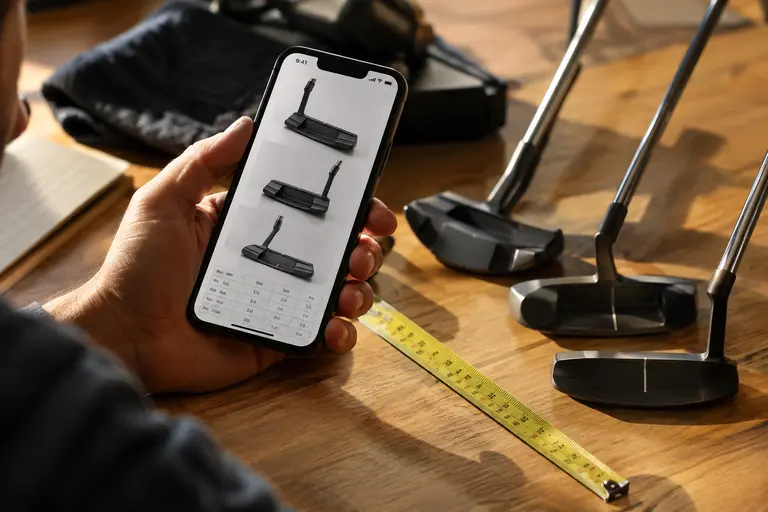
Both models share several core specifications: single-piece 303 stainless steel construction, mid-depth face grooves, Satin Steel or DLC Black finish options, 33-, 34-, and 35-inch lengths, 3 degrees of loft, and a 70-degree lie angle. GolfMagic also reported that both heads use a KBS CT Tour single-bend shaft and a SuperStroke 2.0 PT Takomo Edition grip, with head weights of 362 grams at 33 inches, 357 grams at 34 inches, and 352 grams at 35 inches GolfMagic specs.
The M1 mallet was positioned for golfers seeking higher forgiveness, added stability, and more alignment confidence. It has 14 mm of onset, a mid-mallet footprint, and a longer alignment line to frame the ball. The B1 blade was aimed at players who prefer a more traditional look and precision. It has 8 mm of onset, a compact wide-blade shape, and center of gravity closer to the face to reduce torque.
Fitting Read On Takomo Lumo putters
Why Onset Changes The Address Picture
Onset is one of the first details I would check with these heads. The M1’s 14 mm onset and the B1’s 8 mm onset create different visual relationships between the shaft, face, and ball. Some players aim better when the shaft appears more forward of the face. Others start pushing or pulling putts because the address picture no longer matches their old reference point.
That is why a good test should begin before the golfer rolls ten balls and talks about feel. Set the putter down to a target from six to ten feet and check where the face is actually aimed. If the player loves the look but aims it left or right every time, the head may still need a different length, posture check, grip change, or a different model.
How Low-Torque Should Be Tested
Low-torque design should be tested through results, not belief. I would want to see face angle at impact, start direction, strike location, launch, roll quality, and distance pattern. A player may feel that the head wants to stay square, but the ball has to confirm it. If the putter improves start-line control but distance control gets worse, the fit is not finished.
This is also where head shape matters. The M1 gives the player a larger alignment picture and a mallet profile. The B1 keeps a more compact wide-blade look. Neither shape guarantees better putting. The best fit is the one that helps the player aim naturally and return the face with repeatable speed.
For golfers comparing this category more broadly, our note on modular putter design covers several fit checks that also apply here: head style, torque behavior, face technology, alignment, and what should be tested before ordering.
M1 Mallet Versus B1 Blade In The Bay
Who Should Test The M1 First
The M1 should be high on the test list for golfers who like a clear alignment line, want more confidence behind the ball, or tend to miss the center of the face. Its mid-mallet footprint gives the player more visual structure than the B1. That can be helpful for players who struggle to square a small blade or who want the head to feel more stable on short putts.
The caution is that bigger is not always easier. Some players over-aim mallets because the alignment aid dominates the setup. Others lose touch on longer putts if the head feels too steady or too heavy for their stroke rhythm. The M1 should be tested from short, mid-range, and lag distances before a player treats it as a safer choice.
Who Should Test The B1 First
The B1 belongs in the hands of golfers who want the low-torque concept without giving up a compact, traditional look. Its 8 mm onset and wide-blade shape may suit players who aim blades well but want a head that is built around torque reduction. It also gives fitters a cleaner option for players who dislike large alignment features.
The blade profile does not make it a better player’s putter by default. The fit still has to show whether the golfer can control start line and pace. A compact head can expose poor strike patterns, but it can also free up a player who feels crowded by a larger mallet. That is why the M1 and B1 should be tested side by side, not judged from product photos.
Spec Checks Before Ordering
Length, Lie, And Grip Fit
The available 33-, 34-, and 35-inch lengths cover many players, but they do not replace a length fitting. A golfer’s eye position, posture, arm hang, and stroke arc can all change with a one-inch difference. Since the reported head weight changes by length, the player should also pay attention to how each build feels during tempo and distance-control drills.
The 70-degree lie angle is a common starting point, but it still needs to match setup. If the toe sits up or down too much, the player may change posture to make the putter look right. That can affect strike and face delivery. The SuperStroke 2.0 PT grip is another key variable. Some players love the reduced hand action of a larger grip profile; others lose face awareness.
- Check aim before rolling putts, not after the player adjusts to misses.
- Test both short start-line putts and 25- to 40-foot speed control.
- Compare M1 and B1 with the same ball and same green speed when possible.
- Watch strike location, not just makes and misses.
- Confirm the finish choice does not create glare or visual distraction for the player.
Pricing at launch was reported at US $219 for Satin Steel and $239 for Black DLC, with UK pricing around £199 for steel and £219 for black. That placed the models in a lower-cost bracket than many premium milled or torque-focused putters, but value still depends on fit. A lower price is useful only if the golfer gets the right setup and can return the face consistently.
If a fitting day becomes part of a wider golf trip, our network also includes Bass Lake Roadhouse for a convenient and tasty meal for readers planning where to eat before or after a round.
Takomo Lumo putters: M1 Or B1 Fit Call
The cleanest read is simple: start with the M1 if the player wants alignment help, a mallet look, and a more stable address picture. Start with the B1 if the player wants a compact shape, traditional framing, and a lower-profile head behind the ball. Then let aim, start line, strike, and pace decide.
Takomo Lumo putters gave fitters two useful options rather than one catch-all model. The shared materials, shaft, loft, lie, grip, and length choices make the comparison controlled. The different onset numbers and head shapes create the real fitting split. For golfers curious about low-torque putters, the Lumo M1 and B1 are worth testing with a disciplined process, not a quick roll on a shop carpet.