
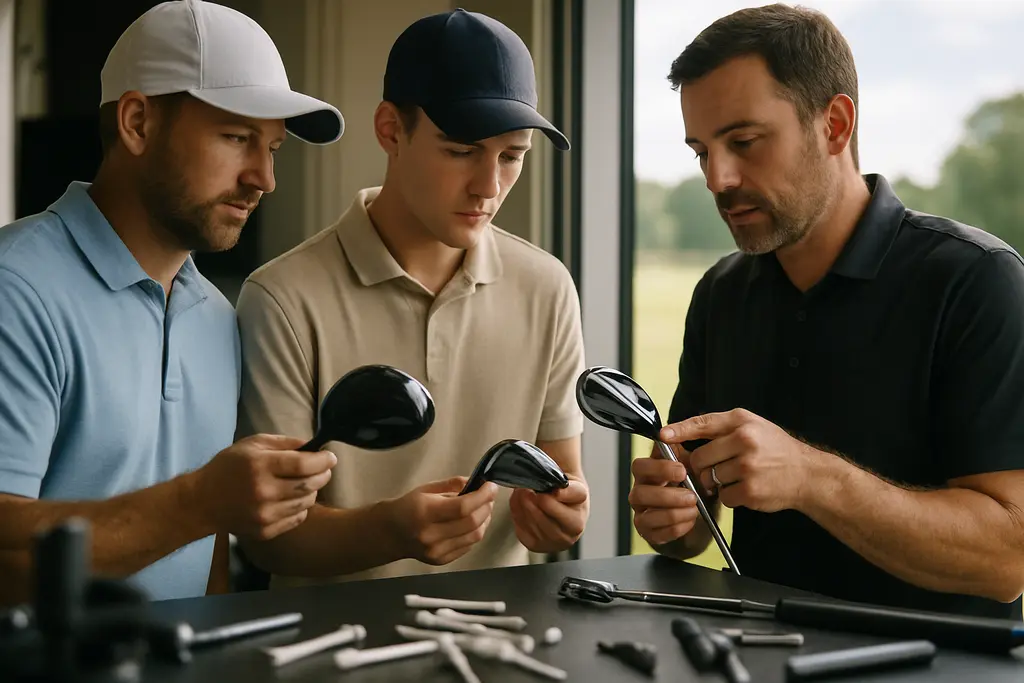
Choosing between national chains and independent shops for club fitting services should start with the fitting work itself: interview quality, launch-monitor use, shaft and head options, build accuracy, and whether the recommendation fits your swing rather than a sales target. The research supplied for this article comes from the auto service market, not golf retail or golf fitting, so it should be read as service-provider context rather than proof of how every golf chain or independent fitter performs.
That limitation matters. Golf fittings are not oil changes, brake jobs, or tire replacements. A good fitting blends measurement, player feedback, build knowledge, and an honest discussion of cost. Still, the auto service data does show a useful consumer pattern: people weigh convenience, trust, pricing, and provider scale differently depending on the job. Those same themes can help golfers ask better questions before booking time in a bay.
How Service Market Data Frames The Fitting Choice
What The Chain Shift Shows
Ducker Carlisle’s 2026 Consumer Sentiment Survey, reflecting 2025 data, found that national repair chains overtook franchised dealerships as the most frequently used auto service provider. Chains rose from 20% market share in 2020 to 42% in 2025, while dealership share fell from 54% to 36%; independent repair facilities declined slightly to 23%, according to MOTOR’s report on service-provider shifts. That is not golf-fitting data, but it is a strong signal that many consumers are comfortable choosing scaled service providers when they believe access, speed, and cost are in balance.
For golf, that suggests why a national chain can be appealing. A golfer may want easy booking, multiple locations, longer retail hours, and the ability to test current products from major brands in one place. If a player is new to fitting, a familiar storefront can reduce friction. It may also be easier to compare fitting sessions with stock on hand, especially for drivers, fairway woods, irons, wedges, and putters carried by the retailer.
Where Pricing Signals Help And Where They Do Not
The same research set shows that provider type can carry very different average transaction costs in auto service. Ducker Carlisle reported mid-2026 average per-service transaction costs of $521.69 for dealerships, $270.52 for general chains, $334.33 for independent repair facilities, and about $106.44 for quick lube shops, as noted by Ducker Carlisle’s service-provider analysis. Those figures should not be converted into golf-fitting prices. They do, though, reinforce a practical point: provider model can shape what a customer pays and what is bundled into the visit.
In golf, the relevant question is less “Which provider type is cheaper?” and more “What exactly is included?” A fitting fee may or may not include build consultation, gapping review, loft and lie checks, shaft testing, putter assessment, or post-build verification. A golfer comparing club fitting services should ask for the scope in plain language before the appointment, then compare that scope against the price and the fitter’s process.
National Chain Fitters: Practical Pros And Cons
Access, Inventory, And Repeatable Process
National chains usually win on access. A golfer who needs an appointment after work, wants to test several current heads, or prefers a store with return visits built into the retail process may find a chain more convenient. The service-market research above supports the broader idea that chains can win share when consumers value ease of booking and familiar service structures, though it does not prove any golf-specific result.
A chain environment can also be useful for golfers who are still learning the category. If you are comparing a driver, a game-improvement iron, a players-distance iron, or wedge loft gaps, seeing product families side by side can help. The risk is that inventory can steer the conversation if the fitting process is not disciplined. A serious fitter should start with your current clubs, strike pattern, ball flight, miss tendency, speed, delivery, and scoring needs before reaching for a new product.
For golfers weighing a free or promotional event against a paid appointment, the distinction is worth slowing down. FS Golf offers a pertinent discussion on brand event fittings versus paid club fittings and why session length, brand range, and spec documentation can change what you get from the fitting.
Potential Limits To Watch
The main concern with a chain is not scale by itself. The concern is fit depth. A chain can employ excellent fitters, and an independent can deliver a weak session. The golfer’s job is to test the process before trusting the recommendation. Ask whether the fitter records final specs, checks lie angle and length logic, explains shaft changes in relation to launch and delivery, and lets you compare the recommended build against your gamer rather than only against another demo club.
Be cautious if a fitting feels rushed, if every answer points to one product line, or if the recommendation appears before enough swings have been measured. Good club fitting services should produce a clear reason for each spec: head model, loft, shaft, flex profile, length, lie, grip, and set makeup. Not every golfer needs exotic components or a full-bag rebuild. Many need a better gap structure, a driver that reduces one side of the course, or irons with lie angles that match impact.
Independent Fitters: Practical Pros And Cons
Specialist Attention And Build Accountability
Independent fitters often appeal to golfers who want a deeper conversation and a more personal build path. The best independents tend to be process-led: they test, explain, document, and think carefully about how a club will be built after the fitting. That can matter for players who need unusual length, lie, swing weight, grip build-up, wedge gapping, or a set composition that does not follow a stock retail pattern.
Because the research supplied is not golf-specific, it would be unfair to claim independents are always more accurate, more honest, or better value in golf. The supported lesson is narrower: in service markets, provider type can influence cost, access, and customer choice. For golf, the stronger test is the individual fitter’s method. A skilled independent should be able to describe why a shaft or head works for you without hiding behind brand language.
Tradeoffs In Access And Product Breadth
The independent route can have limits. Appointment availability may be narrower. Demo matrices may vary by shop. Some independents carry many brands; others focus on a smaller group of heads and shafts. A smaller business may also have different policies around deposits, build timelines, adjustments, or post-build checks. None of that is automatically bad, but it needs to be clear before you commit.
A golfer looking at independent club fitting services should ask about component access, build location, spec tolerances, and follow-up. If the same shop fits and builds, ask how finished clubs are checked. If the build is sent elsewhere, ask what documentation moves with the order. The more custom the recommendation, the more the handoff matters.
Questions To Ask Before Booking A Fitting

The cleanest way to compare chains and independents is to ask the same questions of both. The answers will tell you more than the sign on the building.
- What is included in the appointment? Ask whether the session covers one club type, a gapping review, shaft testing, loft and lie checks, or a full-bag plan.
- Which launch-monitor data will be used? Carry distance, total distance, ball speed, launch, spin, descent angle, dispersion, and strike location all matter in different ways.
- Will I receive final specs in writing? A fitting without documented specs is hard to audit, rebuild, or compare later.
- Can I test against my current clubs? The gamer baseline keeps the recommendation grounded.
- Who builds or orders the clubs? Fitting quality and build quality are connected but not identical.
- What happens if the delivered club does not match the fit? Ask about adjustment policies before paying.
Those questions apply across club fitting services because they focus on evidence rather than provider type. A national chain that answers them clearly deserves consideration. An independent that cannot answer them clearly should not get a free pass just because it feels more specialized.
Using Outside Service Lessons Without Overreading Them
The auto service data is useful because it shows real consumer movement between provider models. Chains gained usage share. Transaction costs differed by provider type. Consumers appear willing to choose different service formats depending on value, convenience, and perceived need. Those are relevant buying behaviors, even if the category is different.
Golfers should still avoid overreading the comparison. A club fitting is a measurement-and-build service tied to athletic motion, personal feel, and equipment rules. The best provider is not automatically the largest, the smallest, the cheapest, or the most premium. The best provider is the one that gives you a clear test structure, explains tradeoffs honestly, and connects the recommendation to your shots.
Utilizing broader consumer-service comparisons while researching providers can be insightful, and consulting a related network resource such as wikiapp may serve as a good reminder to distinguish between convenience, cost, and service scope before making a choice. In golf, that separation is critical because a low-friction appointment is not always the same as a high-quality fit.
Choosing Club Fitting Services With A Clear Fit Plan
The most practical choice between a national chain and an independent fitter starts with your goal. A newer golfer may need basic length, lie, set makeup, and shaft guidance more than a long matrix of premium options. A competitive amateur may need deeper testing, tighter build checks, and a sharper look at dispersion windows. A player fighting one miss with the driver may need a focused wood fitting rather than a full-bag appointment.
Before booking club fitting services, write down what you want solved: too much curve, poor contact, distance gaps, wedge overlap, poor launch, weak descent angle, or putter aim and speed issues. Bring your current clubs. Bring the ball you normally play if the fitter allows it. Ask for the final recommendation in writing, including any no-change recommendations. Sometimes the best fitting result is learning that one part of the bag is already working.
National chains can offer convenience, product access, and a familiar retail process. Independent fitters can offer specialist attention, deeper build discussion, and a more personal relationship. Either can be the right call. The better filter is not chain versus independent; it is whether the fitter proves the recommendation with measured shots, sensible comparisons, and specs you can understand after you leave the bay.