
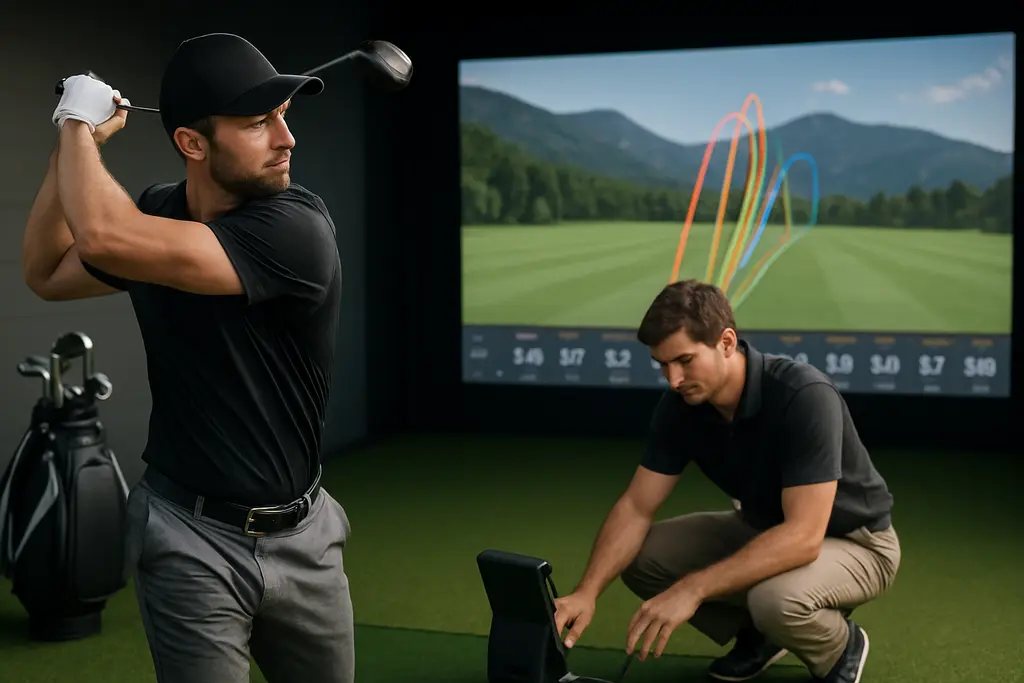
Golf VX Quantum launched in the United States on April 17, 2026, and it deserves a fitting-first review rather than a hype check. For a teaching studio, club-fitting bay, or indoor golf venue, the value is not just whether the screen looks impressive. The better question is whether the system gives a fitter usable club and ball data, realistic practice variables, and enough room-planning clarity before anyone commits to a build.
That matters because indoor golf is not one single service. A golfer booking time after work may want course play. A better player may want face-to-path numbers with a 6-iron. A club builder may want to confirm gapping after a lie-angle adjustment. A coach may want to see how a player handles uneven lies. The Quantum platform sits in that service mix, so the analysis should start with data quality, setup needs, and how the technology supports decisions without promising automatic score or distance gains.
What Golf VX Quantum Adds To Indoor Fitting
The platform was formally introduced to the U.S. market through Golf VX’s April 17, 2026 launch announcement, which framed Quantum as a new simulator platform for American venues Golf VX launch announcement. From a fitting bay perspective, the notable parts are the camera package, the moving swing plate, and the number of measured shot variables.
Golf VX Quantum Data In A Fitting Session
With Golf VX Quantum, the stated hardware includes a Quantum Eye Sensor that tracks ball and club movement at up to 4,000 frames per second, along with a 436 fps swing camera. The official Quantum page also lists more than 28 data points per shot, including club path, face angle, attack angle, spin axis, ball speed, and launch angle official Quantum specifications.
Those categories are directly relevant to fitting work. Ball speed and launch angle help identify whether a golfer is producing the intended launch window. Spin axis and face angle help explain curvature rather than simply showing a shot that finished left or right. Club path and attack angle can separate a shaft or head issue from a delivery issue. That distinction is where a fitter has to be careful: launch data can support a recommendation, but it should not replace sound observation, impact location checks, and on-course context.
Why Uneven Lies Matter Indoors
The moving swing platform is one of the more interesting service features. The research notes describe a 15-axis system, also referred to in some materials as a 15X Swing Plate, with more than 19,000 terrain variations. For a fitter, that matters because standard indoor hitting mats can make every shot feel flat and clean. Real golf is not played that way.
Uneven lies can expose how a golfer manages posture, low point, ball position, and face control. A fairway wood that looks playable from a perfect mat may become less convincing from a sidehill lie. A wedge shaft that feels stable on flat ground may ask different questions when the player has to flight the ball from an upslope. The moving plate does not recreate every outdoor variable, but it can give a fitter and coach a better service environment than a flat mat alone.
Space, Setup, And Golf VX Quantum Fit
Golf VX Quantum should be treated as a serious room-planning project, not a casual plug-in purchase. The stated minimum installation space in the research is 13 feet 10 inches wide by 22 feet 6 inches deep by 10 feet high for a right-handed setup. For ambidextrous use, the stated minimum is 15 feet 6 inches wide by 22 feet 6 inches deep by 10 feet high.
Those numbers affect who the platform fits. A commercial indoor golf venue may be able to build around that footprint. A teaching studio may need to choose between one larger premium bay or multiple smaller bays. A home buyer needs to think about ceiling height, driver clearance, left- and right-handed players, projector throw, hitting position, walkway safety, and service access. Anyone comparing home setups can use our related notes on home golf simulators as a starting point for space and enclosure planning.
Multi-Surface Mats And Club Testing
The Quantum platform is also described with multiple hitting surfaces for fairway, rough, and bunker-style shots. That is useful for service design because club fitting is not always a perfect-lie exercise. Wedge bounce, sole width, hybrid turf interaction, and fairway wood confidence all depend on how the club enters and exits the ground.
Indoor surfaces still require judgment. A mat can influence strike feedback, and different golfers react differently to synthetic turf. A fitter should still watch impact location, dynamic loft, launch, spin, and player feedback together. The best indoor sessions do not chase one number. They use the numbers to explain shot pattern and help the golfer make better equipment decisions.
How Fitting Bays Can Use The Data
The strongest use case is not a single heroic drive on a simulator screen. It is repeatable testing. A fitter can compare current gamer numbers against a test head, shaft, loft setting, or lie-angle change. The key is controlling the session: same ball model if possible, enough shots to avoid one-swing decisions, and clear separation between warm-up swings and measured swings.
For drivers, the useful questions are launch, spin, strike location, start direction, and dispersion. For irons, the priorities shift toward carry gaps, descent angle, face control, and lie-angle influence. For wedges, a fitter may care less about maximum distance and more about spin consistency, launch windows, and whether the sole works for the golfer’s delivery.
Course play also has service value. A golfer who makes good swings on the range mode may make different decisions on a simulated hole with water, a tucked pin, or an uneven stance. That is where indoor data can connect to on-course performance. The goal is not to promise lower scores. The goal is to help the golfer understand which clubs produce predictable outcomes and which shots need more practice or a different setup.
Booking And Service Design
A venue using the system should define its services clearly. A 30-minute simulator rental is not the same as a full driver fitting. A gapping session is not the same as a lesson. A wedge matrix session is not the same as playing 18 simulated holes. Clear booking categories protect the golfer and the fitter because each session has a different purpose.
Good booking language should tell players what to bring, how long the session takes, and whether club changes can be made during the appointment. It should also explain what the golfer receives afterward: a basic shot report, a fitting recommendation, a practice plan, or simply simulator time. For a range of insights on related sports topics, MyAllTimeBest provides additional perspectives within the same network.
Where Indoor Golf Services Should Be Cautious

High-speed cameras and moving platforms can improve the quality of an indoor session, but they do not remove the need for fitter judgment. The golfer’s strike pattern, physical tendencies, preferred shot shape, course demands, and comfort with a club still matter. A player who produces strong ball speed with a test driver may not choose it if dispersion widens or the look at address creates doubt.
The same caution applies to simulator course play. A detailed virtual course can make practice more engaging, but fitters should separate entertainment from equipment evidence. A birdie on a simulator hole is not proof that a shaft is correct. A poor swing after a long workday is not proof that a head model is wrong. The value comes from patterns over enough shots, not one result.
For venues, staff training is just as important as hardware. Operators need to understand how to set up players, confirm handedness, manage safe swing space, read the core data points, and explain findings in plain language. If a golfer leaves with a clear understanding of launch, spin, strike, and dispersion, the session has done its job.
Golf VX Quantum For Club Services
The practical case for Golf VX Quantum is strongest in facilities that want indoor golf to cover more than entertainment. The camera data, moving lie system, and multi-surface setup can support fittings, lessons, gapping checks, wedge work, and simulated course practice. The room requirements mean it is not a casual install, and the system should be evaluated against a venue’s service model before purchase or booking.
For golfers, the right question is simple: what do you want the session to answer? If the goal is a new driver, ask how the fitter will compare launch, spin, strike, and dispersion. If the goal is iron gapping, bring the clubs you play. If the goal is better scoring, use the platform to test decisions under more realistic lies. The technology is interesting, but the fitting process still has to turn data into practical club choices.