
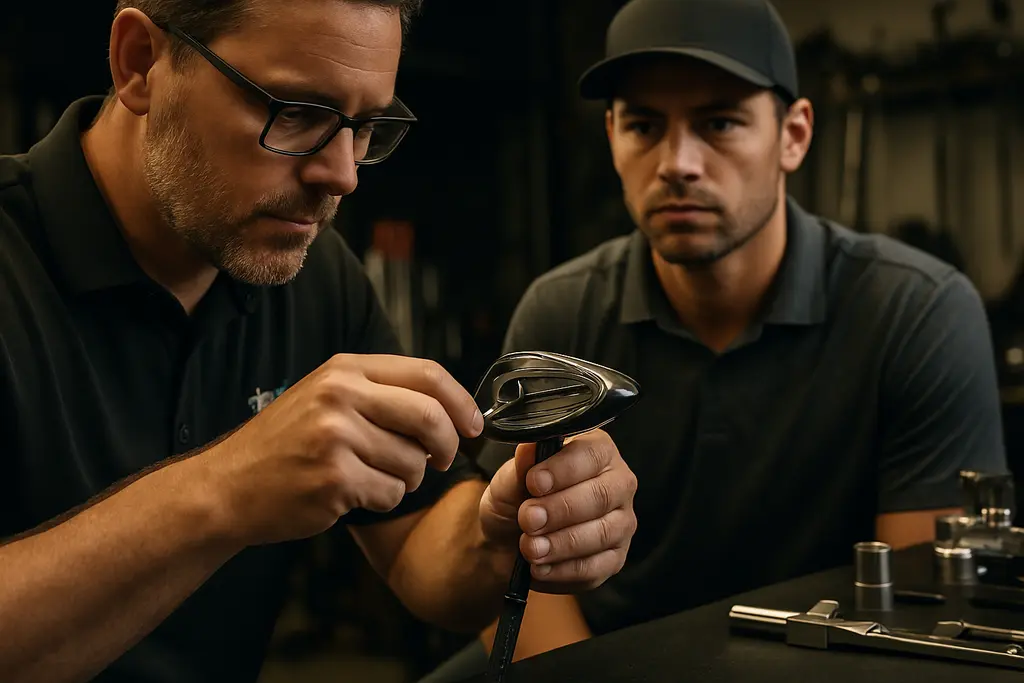
PGA Tour Fitting took a clear step forward on September 25, 2026, when Club Champion announced a partnership with Scott E.G. Golf to bring its services directly to the PGA Tour environment. For golfers who care about the fitting process, the key point is not celebrity access or tour-truck mystique. It is the service model: better data capture, more build control, and faster movement from test result to finished club.
As a fitting specialist, I read this kind of news through a practical lens. Tour players need exact windows: launch, spin, descent, face control, start line, shaft feel, and gapping that holds up under tournament pressure. Recreational golfers do not need the same schedule pressure, but they can learn from the process. A good fitting is not a sales event first. It is a structured test of what the player brings, what the ball does, and which build changes are worth making.
Why PGA Tour Fitting Moved Closer To The Build Van
The Scott E.G. Golf Partnership
Club Champion said on September 25, 2026, that its partnership with Scott E.G. Golf brought full services, including SST PURE shaft-analysis technology, directly to the PGA Tour through the announced partnership. That matters because tour service is often judged by how well the fitter, builder, and player can close the loop. A player may test a head and shaft combination, ask for a small lie or swingweight change, and then need the club built with the same intent that came out of the fitting bay.
SST PURE is especially relevant in that setting because the system identifies the most stable orientation of a shaft before installation. That does not mean every golfer will feel a dramatic change, and it should not be sold that way. The better reading is more grounded: if a player or fitter is trying to control variables, shaft orientation is one more build variable that can be measured before epoxy goes in the hosel.
PGA Tour Fitting Starts With A Better Baseline
The strongest fitters I know do not start by guessing at new product. They start by measuring the player’s current club. That baseline tells the fitter what the player is already producing: speed, launch, spin, strike pattern, dynamic delivery, curvature, carry distance, and dispersion. On Tour, that baseline is often very refined. The player may already have a functional setup, so the fitter is hunting for smaller tolerances, not a complete rebuild.
That is where build access becomes more than convenience. If the test club and the finished club are not close enough in playing length, loft, lie, shaft build, swingweight, and grip, the fitting result can get watered down. Bringing more services near the tour setting helps reduce that gap. The same principle applies in a retail studio: the recommendation is only as useful as the build quality behind it.
Booking Lessons For Everyday Golfers
Pick The Session By Problem, Not Ego
The first takeaway from PGA Tour Fitting for regular players is simple: book the fitting that matches the decision you need to make. A full bag session can make sense if your set has age gaps, random shafts, unclear wedge spacing, or a putter that no longer matches your stroke. A narrower session is usually better if you only need to solve one issue, such as driver launch, iron dispersion, wedge gapping, or putter aim.
Club Champion’s booking model reflects that split. The research notes list fitting types such as full bag, driver, iron and wedge, putter, and wedge sessions. The full bag fitting is described as about three hours, while a wedge session can be about one hour. The notes also state that pricing is tiered, with a full bag session listed between $100 and $400 depending on whether custom equipment is purchased. That kind of structure helps golfers avoid paying for time they do not need, while still giving enough room for full-set testing when the bag calls for it.
If you are preparing for a first appointment, the smartest move is to define the problem before you choose the session. Our related breakdown of the club fitting process is useful because it frames the appointment around intake questions, launch-monitor data, spec testing, and follow-up notes rather than brand preference alone.
What To Bring To The Bay
A fitter can do better work when the player arrives with useful context. Bring your current gamer clubs, recent ball choice, and honest notes about where shots go on the course. Do not only describe your best strike. Describe the miss you are trying to reduce. Tour players are excellent at that. They often know whether the miss starts left, over-curves, falls short, or launches outside the intended window. Amateur players can help themselves by being just as direct.
- Bring the clubs you currently play, not just the club you want to replace.
- Know your common miss, usual course conditions, and preferred ball flight.
- Ask which change affected the result: shaft, head, loft, lie, length, grip, or swingweight.
- Request your final specs in writing so future adjustments have a starting point.
The fitting bay is not separate from the course. If your 7-iron test looks good indoors but creates a yardage overlap with your 6-iron and 8-iron, the set still has a problem. If your driver adds ball speed but produces a wider miss pattern, the fitter should treat that as a tradeoff, not a win by default.
Data And Build Controls Behind The Service

Launch Monitor And Putter Data
Club Champion says it operates more than 160 fitting studios nationwide and combines fitting technology such as TrackMan, SAM PuttLab, proprietary AI tools, Master Fitters, and Master Builders across its studio model. TrackMan data is useful because it gives the fitter measured ball flight and club delivery information. SAM PuttLab belongs in the same conversation for putting because a putter fitting needs more than a player saying the head “looks right.” Stroke path, face behavior, aim tendencies, and impact consistency all matter.
The research notes describe Club Champion’s process as stepwise: baseline measurement of the player’s current clubs, shaft profiling first, then clubhead selection, followed by adjustments in length, loft, lie, swingweight, and grip. That order is sensible. Shaft testing can influence timing and strike. Head testing can change launch, spin, forgiveness, and shape bias. Loft and lie can fine-tune start direction, turf interaction, and gapping. Grip choice can affect face awareness and comfort. None of those decisions should be made in isolation.
Component Choice And Build Follow-Through
The research notes also state that Club Champion offers access to more than 65,000 head, shaft, and grip combinations across major equipment brands. The point is not that every golfer needs to test a huge number of combinations. In a good fitting, the fitter should narrow the test matrix quickly based on the player’s delivery, strike, speed, and feedback. A large component matrix is useful only if the fitter can filter it down to options that answer the player’s problem.
Club Champion has also added its proprietary A.I. Fitter Co-Pilot system, according to the research notes. Used properly, that type of tool should support the fitter rather than replace the fitter. Golf swings are not spreadsheet entries. Two players can create similar launch numbers for different reasons, and the build recommendation may not be the same. The human part of the job is reading the player, watching strike, listening to feedback, and knowing when a number is useful or misleading.
The company’s Perfect Fit Guarantee, as described in the research notes, also sits on the build side of the service. Customers receive email updates during the build process, and clubs are built to the exact specs determined during fitting. That is the part many golfers underestimate. A launch-monitor session can identify a strong fit, but the finished club still has to match the intended build.
What Golfers Should Learn From PGA Tour Fitting
Tour Service Is Not A Shortcut
The useful lesson from PGA Tour Fitting is not that every golfer needs a tour-level build room or every available shaft. The lesson is that process matters. Start with the current club. Measure the ball flight. Change one main variable at a time when possible. Confirm the build spec. Then judge whether the new setup improves the shot pattern enough to justify the order.
For golfers who follow athlete preparation across sports, our network site world football coverage shows a similar idea from another angle: performance support works best when the service matches the athlete’s real demands. In golf, that means the club has to match the swing, the course, and the scoring job it is asked to do.
No fitting should promise lower scores or extra distance on command. A better fit can give a player a more sensible equipment setup, cleaner gapping, and fewer build variables left to chance. Whether that turns into better scoring depends on swing quality, practice, decisions, short game, putting, and course management.
Club Champion’s move with Scott E.G. Golf gave its service model a more visible Tour presence after the September 25, 2026 announcement. For the everyday golfer, the booking takeaway is clear: choose the right session, bring your current clubs, ask for the data behind the recommendation, and make sure the finished build matches the specs that earned the spot in your bag.