

The club fitting process can feel unfamiliar the first time you walk into a new shop, studio, or range bay. The best way to lower the stress is to understand the order of events: a player interview, baseline swings with your current clubs, testing different components, narrowing the specs, and leaving with clear notes rather than guesswork.
For beginners, the goal is not to buy the most advanced-looking club on the wall. It is to learn which club length, shaft feel, loft, lie angle, head style, and grip size help your normal swing produce playable results. A new location may use different technology, different hitting conditions, and a different fitter’s process, so the session should be judged by clarity, not sales pressure.
How The Club Fitting Process Works At A New Location
Club Fitting Process Questions To Ask First
Before you start swinging, ask how the session will be structured. A typical fitting includes five phases: player interview, baseline testing with your current clubs, trials with club heads and shafts, optimization of specs, and documentation of recommendations, as outlined in Golf Blab’s 2026 fitting steps reference fitting process guide. That sequence matters because it gives the fitter a starting point before any new club is judged.
The interview is where you should be honest. Tell the fitter how long you have played, what your common miss looks like, whether you struggle with height, and whether you want help with one club or the whole set. If you are a beginner, do not pretend to have a settled swing if you do not. A good fitter can still work with a developing motion, but the recommendations may focus more on sensible setup, forgiveness, gapping, and comfort than on chasing a narrow performance window.
Ask what launch monitor will be used. TrackMan, Foresight GCQuad, and FlightScope are commonly seen names in fitting settings, but the brand is less important than how the fitter explains the numbers. You should also ask whether the session is indoors or outdoors, whether you may use your gamer golf balls, and whether any fitting fee is credited toward a purchase. Fee policies vary by location, so get that answer before the first swing.
What To Bring To The Bay
Bring your current clubs, even if they are hand-me-downs or a mixed set. Baseline testing is much stronger when the fitter can compare new trials against the clubs you already play. Bring golf shoes or stable athletic shoes, comfortable clothes, and any glove you normally wear. If the location allows it, bring the ball model you use on the course, because ball speed, launch, and spin readings are easier to compare when the ball is consistent.
If you are booking your first session, a little prep helps. Our related primer on beginner club fitting preparation covers what to bring and how to think about the session before you arrive. Also, when you’re exploring regional resources for planning travel or comparing locations, the comprehensive information on Ambikapur City might be particularly enlightening.
Launch Monitor Data Beginners Should Understand
Measured Numbers Versus Modeled Numbers
Launch monitors are central to modern fitting, but they are not magic scorecards. They help the fitter compare shots under controlled conditions. Some systems use Doppler radar, some use high-speed cameras, and some use hybrid setups. These tools can directly measure ball speed, launch angle, and spin rate, while other values such as carry distance, club path, and face angle may be derived or modeled depending on the system, as explained by Northcourse in its plain-language launch monitor explainer.
That distinction is useful for a beginner. If a fitter shows you a carry number, ask what changed between your old club and the test club. Was ball speed better? Did spin move into a more playable range? Did launch improve? Did the strike move closer to the center of the face? One long shot is not enough to decide. A good fitting looks for a repeatable pattern across several swings, while also removing obvious mishits from the main comparison.
Why Indoor And Outdoor Settings Feel Different
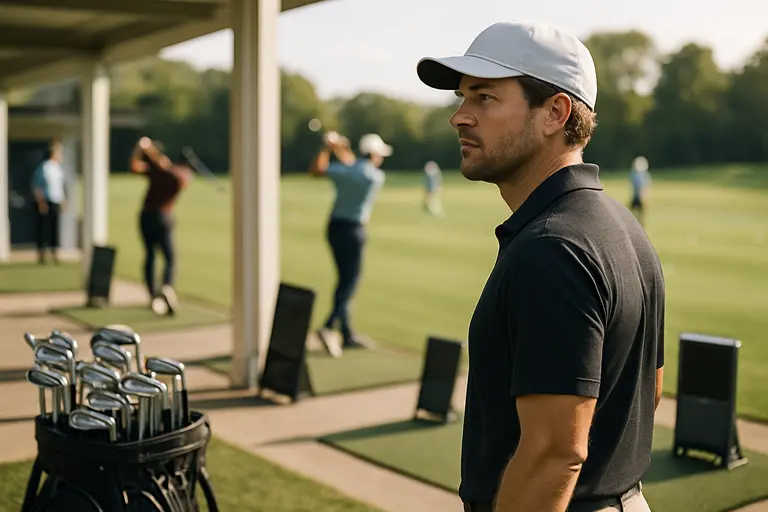
A new location may be an indoor studio, a covered range, or an outdoor grass fitting area. Each setting has tradeoffs. Indoors, the fitter can often control weather, ball supply, and camera placement. Outdoors, you may see the full ball flight, turf interaction, and wind response. Neither setting is automatically better for every golfer. The key is whether the fitter understands the tool being used and can connect the data to shots you recognize.
Beginners should pay close attention to dispersion, not just distance. A driver that adds speed but widens the miss pattern may not help you score. An iron shaft that feels smooth but creates inconsistent contact may not be the right match. A hybrid that launches higher and lands softer may be useful if it fills a gap, but only if the gap makes sense next to your longest iron and fairway wood. The numbers should support a playing decision.
Specs That Usually Matter First
Length, Lie, Loft, And Grip Size
The club fitting process usually works through several core specifications: shaft flex, shaft weight, club length, loft, lie angle, and grip size. Those specs interact. A longer club may create more speed for some players, but it can also make center contact harder. A lie angle that is too upright or too flat for your setup can encourage a repeated directional miss. Loft influences launch and distance, but it also affects how a club fits into the rest of the bag.
Grip size is easy to overlook because it does not look as technical as a launch monitor chart. For a beginner, though, grip comfort can affect face control and tension. If the grip feels too small or too large, you may change your hand pressure without realizing it. That does not mean grip size fixes every miss. It means the fitter should treat it as part of the whole build, not an afterthought.
Shaft Flex And Shaft Weight
Shaft flex should be based on how you swing, not on ego. Many new golfers assume stronger means stiffer, but the fitting bay should test what produces playable launch, spin, strike, and face control. Shaft weight is just as important. A lighter shaft can help some slower-speed players create speed and launch, while a heavier shaft can help some faster or quicker-tempo players keep the club organized. Those are tendencies, not rules.
A practical fitter will let you hit enough shots to see whether a pattern is forming. If a trial shaft produces one perfect shot and five weak ones, that is not a fit. If another option feels less dramatic but keeps the strike and start line steadier, it may be the smarter golf choice. This is where launch data and player feedback have to meet. The club must measure well and make sense in your hands.
How To Judge A New Fitting Location
Signs Of A Useful Session
A good session should feel organized. The fitter should explain the baseline, tell you what is being changed, and avoid changing too many variables at once. If the head, shaft, length, and loft all change together, it becomes harder for a beginner to know what caused the result. Better testing isolates changes when possible, then confirms the full build after the preferred parts are identified.
Watch how the fitter handles poor swings. Beginners will hit thin shots, heavy shots, pulls, pushes, and face-open blocks. That is normal. The useful question is whether the club reduces the severity of your normal miss or exposes a problem the fitter can explain. A fitting is not a lesson, but it should respect your swing pattern rather than punish you for being new.
Red Flags To Slow Down
Be careful if the session turns into a quick sales pitch before enough baseline data is gathered. Be careful if only total distance is discussed. Be careful if the fitter cannot explain why a recommended shaft, lie angle, loft, or head style fits your shot pattern. The recommendation does not need to be complicated, but it should be traceable to what happened in the bay.
- Ask for your final specs in writing, including shaft model or profile, length, lie, loft notes, grip size, and head recommendation.
- Ask which clubs should be replaced first if your budget does not allow a full set.
- Ask how the recommended clubs create better gapping through the bag.
- Ask whether adjustments can be checked after you have played several rounds.
The club fitting process should leave you with decisions, not pressure. A beginner may be better served by fitting the most troublesome part of the bag first: driver if tee shots are costing penalties, irons if contact and gapping are inconsistent, or wedges if approach distance control is the issue. A full-bag fit can be useful, but only if you have the energy to make enough swings and the fitter can keep the data clear.
Club Fitting Process Takeaways For Beginners
The club fitting process at a new location is easiest to trust when it follows a clear order: talk first, test your current clubs, change one or two variables at a time, compare the data, and document the build. Launch monitors give the session structure, but the best fit still depends on how the club performs for your normal swing.
Do not expect one appointment to fix every scoring problem. Clubs cannot replace practice, course management, or instruction. What a sound fitting can do is remove equipment that is clearly working against you and replace guesswork with informed choices. For a beginner, that is enough reason to take the session seriously, ask direct questions, and leave with specs you understand.