

Higher Lofted Woods are no longer a niche fix for slower swingers or players who dislike long irons. They have moved into serious fitting conversations because the top end of the bag has to solve a real course problem: carrying the ball far enough, landing it steep enough, and keeping misses playable from fairway, rough, and tee boxes.
The fitting question is not whether every golfer should copy a tour bag. That would be lazy. The better question is whether a 7-wood, 9-wood, or similar fairway wood creates a cleaner distance window than the long iron, utility iron, or hybrid already in the bag. For many players, the answer cannot be found by loft alone. It shows up in launch, spin, peak height, descent angle, strike pattern, and how the club behaves on the shots the golfer actually faces.
Why Higher Lofted Woods Are Showing Up
The clearest signal came from elite bags in 2026. At the Oct. 1-3, 2026 Presidents Cup, 6 of the 24 players carried a 7-wood, while Jacob Bridgeman and Adam Scott carried 9-woods. That meant 8 players used fairway woods with lofts of 21 degrees or more, according to MyGolfSpy’s Presidents Cup gear report. That is a useful snapshot because those players are not choosing clubs for comfort alone. They are building shots for specific yardages, trajectories, and course demands.
Higher Lofted Woods In Tour Bags
Tour usage does not prove a club will fit a club golfer, but it does change the starting point. A 7-wood used to be treated by some golfers as a specialty club. Now it is a normal testing option in the long-game bay. In a 2026 tracked sample across PGA, LPGA, and LIV players, 50 of 53 players carried at least one fairway wood; 17 carried a 7-wood, 39 carried a 3-wood, and 14 carried a 5-wood, based on ifrothgolf’s fairway wood tracking.
That matters for fittings because better players are often the first to expose weak assumptions. One old assumption was that the top of the set should run driver, 3-wood, hybrid or long iron, then irons. That structure still works for some golfers. It just should not be treated as automatic.
What The 7-Wood Trend Really Signals
The trend is less about one model or one loft and more about playable carry. A fairway wood head is usually larger than a long iron head, and the design gives fitters another way to help a golfer launch the ball without asking for a perfect strike. That does not guarantee more distance. In some fittings, a long iron may still be faster, lower spin, and better into wind. In others, the fairway wood may carry a similar number but stop faster and miss in a safer pattern.
For an in-shop fitting, that is the whole point. Higher Lofted Woods should be tested against the club they are meant to replace, not judged from a rack or a launch monitor number taken in isolation.
What Changes In A Long-Game Fitting
A good long-game fitting starts by identifying the weakest gap. It might be the 4-iron that flies too low. It might be a hybrid that turns over too much. It might be a 3-wood that only works from a tee. The club label is secondary. The shot requirement comes first.
Test Carry Gaps, Not Club Labels
The most common mistake is comparing total distance indoors and stopping there. Total distance can be distorted by rollout assumptions, turf firmness, and launch monitor settings. Carry distance is usually the cleaner starting point because the golfer needs to know whether the ball can cover a bunker, pond, corner, or front edge.
From there, the fitter should look at how each option lands. A long iron that carries close to a 7-wood may still land too flat to hold a green. A hybrid may produce enough carry but miss left for a golfer whose delivery closes the face. A 9-wood may create height but overlap too closely with the next club down. None of those outcomes make a club good or bad on its own. They simply show whether it fits the bag.
Watch Shaft Length And Strike Location
Fairway woods can be easier to launch for some players, but they are also longer than comparable irons. That extra length can help create speed, yet it can also move strike around the face. This is where the fitting gets practical. If the best shots are excellent but the average strike spreads too much, the build may need a different shaft, length, head setting, or grip setup.
Higher Lofted Woods also need to be tested from more than one lie if possible. A golfer who wants the club for second shots into par 5s needs to know how it performs from fairway turf. A golfer who wants a tee club on tight par 4s needs to see start line and curvature. A golfer replacing a long iron should see whether the new club works from light rough, not just a perfect mat.
Woods, Hybrids, And Long Irons Are Different Tools
The current movement toward more lofted fairway woods does not mean hybrids are obsolete. It means the fitting conversation has become more specific. Hybrids still help plenty of players, especially those who like a shorter club, prefer an iron-like setup, or need a shape that fits between fairway wood height and long-iron control.
Where A Hybrid Still Makes Sense
A hybrid can be a better fit when a player wants a flatter window, uses the club often from rough, or struggles with the longer shaft of a fairway wood. Some golfers also aim hybrids more comfortably because the head shape looks closer to an iron. Confidence at address is not a launch monitor metric, but it affects the swing a player is willing to make.
Long irons and utility irons still have a place too. A faster player who likes to flight the ball down may prefer that profile, especially in wind. The point is not to chase the newest pattern from tour bags. It is to build a top end that covers real yardages with shots the golfer can repeat. For a deeper discussion of this exact tradeoff, our related piece on how hybrid clubs compare with woods and utilities works through the same fitting problem from another angle.
Pricing And Upgrade Questions Before You Order
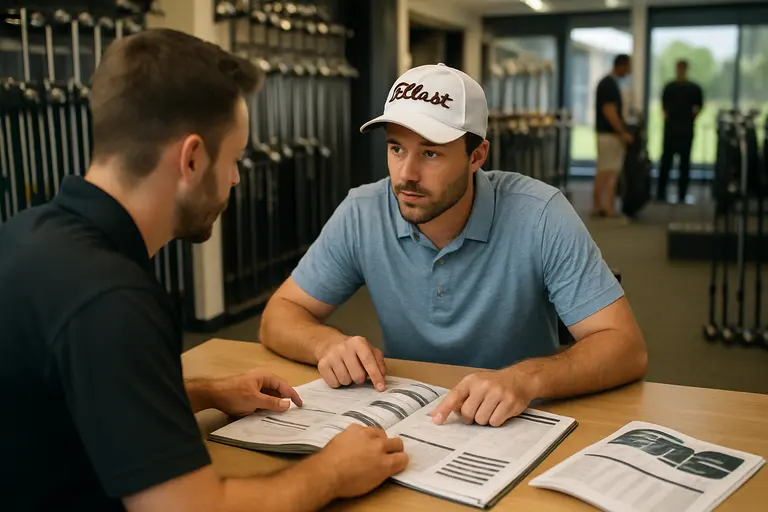
Higher Lofted Woods can affect the price of a fitting or build because they often invite shaft testing, gapping work, and a closer look at set makeup. That does not mean a golfer needs to replace several clubs. In many cases, the smartest upgrade is one club that fixes one gap.
Start With The Gap You Cannot Cover
Before ordering, the golfer should be able to answer a simple question: what shot is missing? If the answer is “I need something between my 5-wood and 5-iron,” the test should focus on that carry window. If the answer is “my 4-iron never gets high enough,” the test should compare peak height and descent angle. If the answer is “my hybrid goes left,” face angle, shaft profile, lie interaction, and head shape all deserve attention.
Pricing transparency also means knowing what is being changed. A head-only swap is different from a full build with an upgraded shaft and grip. A loft adjustment is different from a new club. A fitter should be able to explain why each part is being recommended, what alternative was tested, and what problem the final build solves. Golfers who like comparing fitting and equipment ideas across related sites may also find useful gear context at Back2Tap, a related site in the same network.
One practical caution: do not remove a club just because a trend says it is old. If a 4-hybrid flies the right number, starts on line, and stops well enough for your course, it has earned its spot. If a 7-wood beats it across the shots you actually play, then the change is worth considering.
Higher Lofted Woods In Your Fitting Plan
The best use of Higher Lofted Woods is as a testable answer, not a preset answer. Bring your current long iron, hybrid, or fairway wood to the session and compare it directly. Hit enough shots to see the average, not just the best one. Pay attention to carry, height, landing angle, left-right spread, and whether the club gives you a shot you trust on the course.
If the fitting shows a 7-wood or 9-wood gives you a better gap and a more useful flight, the trend has done its job. If the numbers point back to a hybrid, utility iron, or your current club, that is just as valuable. Good fitting is not about copying the tour. It is about using better options to make the top of your bag easier to understand and easier to play.