

USGA Equipment Limits have become a real fitting-room topic because club length is no longer just a comfort or speed conversation. For golfers who play organized events, the question is also whether a driver build fits the conditions of competition. That does not mean every player needs a shorter driver. It does mean the fitter should know what kind of golf the player actually plays before recommending length, shaft weight, swing weight, or a build sheet.
The key point is simple: the standard Rules of Golf and optional competition conditions do not always ask the same thing of a club. A player who only plays casual rounds may face a different practical decision from a player entering events that adopt stricter equipment terms. The fitting process should catch that early, before anyone falls in love with a club that may not suit the events on the calendar.
What USGA Equipment Limits Actually Say
USGA Equipment Limits And Event Eligibility
On March 13, 2023, the USGA and The R&A sent a proposal notice to equipment manufacturers tied to new Model Local Rules, including a possible maximum club length of 46 inches, excluding putters, for competitions that choose to use it. The same USGA Distance Insights material framed rising hitting distance as a concern for course design, sustainability, and the balance of skills in golf USGA Distance Insights. The proposal notice also identified January 1, 2026, as the date such a Model Local Rule was slated to take effect if adopted for tournaments choosing to use it.
That last phrase matters. A Model Local Rule is not the same as every golfer suddenly needing a new driver. It gives competition organizers a way to set a condition for their events. A club fitter, then, should not ask only, “What gives you the best launch number today?” The better first question is, “Where will you use this club?”
How Club Length Is Measured
The current USGA Equipment Rules state that clubs other than putters must not exceed 48 inches. The same equipment rule reference also notes that committees may adopt Local Rule G-10, which limits non-putter club length to 46 inches, and explains that woods and irons are measured with the club on a horizontal plane and the sole set against a 60-degree plane, from the intersection of those planes to the top of the grip USGA club rule.
For fitting purposes, that measurement detail is not trivia. A driver listed, described, or assumed to be a certain playing length still needs to match the governing measurement method if event compliance is part of the decision. A fitter should avoid vague language such as “about legal length” and keep the build notes clear enough that the player, builder, and event staff are all working from the same idea.
How Driver Length Changes The Fitting Conversation
Longer Does Not Mean Better For Every Player
Driver length can influence clubhead speed, strike location, start line, face control, and dispersion. The fitting job is to sort those variables rather than chase one number. A longer shaft may help one golfer create more speed, while another loses center contact and gives back any ball-speed gain through poorer strike. The proposed 46-inch competition option narrows the space for very long builds in events that use it, but it does not remove the usual fitting tradeoffs.
This is where a practical fitting session earns its fee. The golfer should hit more than one length only if the test answers a clear question. If the player competes under a 46-inch condition, testing a longer driver as the main build may be wasted time. If the player plays social golf only, the fitter can still compare lengths, but the discussion should include control, contact pattern, and whether the player can return the face consistently on the course.
What Changes If 46 Inches Applies
If an event uses a 46-inch non-putter limit, the build menu changes. Extra-long shafts and oversized driver-length experiments become less relevant for that player’s competition set. The fitter may spend more time on head choice, loft sleeve setting, shaft profile, shaft weight, grip size, and final swing weight to keep the club playable inside the permitted length.
| Fitting Question | Why It Matters | Practical Fit Response |
|---|---|---|
| Will the golfer play events using Local Rule G-10? | That can set a 46-inch non-putter limit. | Test driver builds at compliant lengths first. |
| Is the current driver longer than 46 inches? | It may not suit some competition conditions. | Measure by the accepted method and document the result. |
| Does shorter length affect strike quality? | Center contact can change launch and dispersion. | Compare impact pattern, launch, spin, and shot shape. |
| Is the golfer buying for social play only? | The 48-inch rule may still be the relevant standard. | Explain the difference before ordering the build. |
The fitting answer is not automatically “shorter is better.” It is also not “longer is better until the rule stops you.” The answer depends on the golfer’s event needs and the data from the session. Good launch-monitor work should separate usable speed from loose speed.
Testing Choices In The Fitting Bay
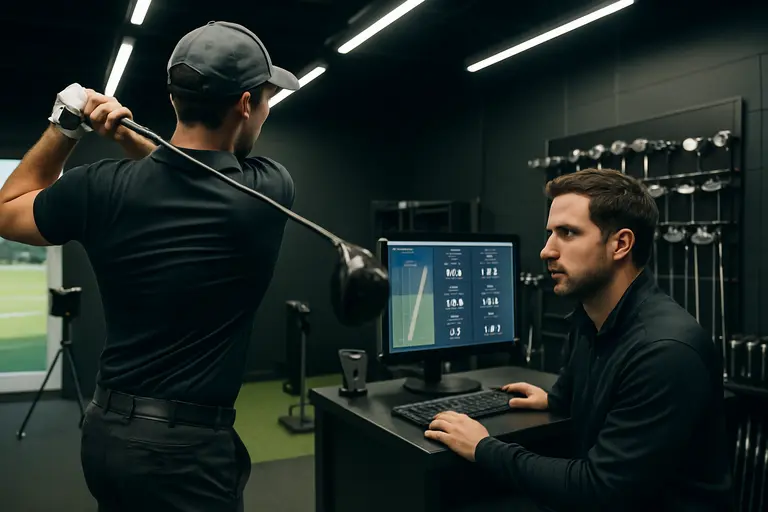
Start With The Golfer’s Schedule
Before the first shaft change, the fitter should ask where the club will be used. Casual weekend golf, club championships, state or regional events, and invitationals can each bring different equipment expectations. If the player is unsure whether a committee uses a 46-inch condition, the safest fitting note is to verify the event terms before ordering anything close to the limit.
That booking question saves time. A player who competes often may need a driver build that is plainly suitable for those events. Another player may want two test paths: one configuration for everyday play and one that stays inside likely competition conditions. Either path should be explained without promising distance or score gains.
Use Data Without Letting One Number Take Over
A driver test around length should include more than clubhead speed. Ball speed, launch angle, spin, carry, total pattern, offline dispersion, and face contact all help show whether the golfer can use the setup. Fitters should also watch the player’s delivery. If a longer club changes posture, tempo, low point, or strike pattern, the best single shot of the session can be misleading.
For players who want a cleaner explanation of launch-monitor terms before they book, this site’s primer on fitting metrics pairs well with a rules-aware driver session. The goal is not to bury the player in numbers. The goal is to show which numbers repeat and which ones came from a swing the golfer cannot take to the first tee.
The same logic applies to ball choice. The research around distance control has included golf balls as well as clubs, and any future equipment condition can affect how fitters think about total set makeup. Still, a driver-length test should not pretend to solve every ball and club question in one appointment. If the driver is the concern, test the driver well, document the result, and schedule deeper ball or bag work separately if needed.
Booking A Fit Around USGA Equipment Limits
Questions To Ask Before The Appointment
A golfer booking around USGA Equipment Limits should bring the current driver, know its stated playing length if available, and list the events where the club will be used. If the player has a tournament schedule, the fitter should know that before shafts come out of the matrix. For broader sports coverage across the same network, readers can also follow SportsWireNews, but equipment compliance questions should always be checked against the relevant golf authority or event committee.
- Ask whether the fit is for casual play, competition play, or both.
- Bring the current driver so the fitter can measure and compare it.
- Request that final build notes include playing length and key settings.
- Confirm event conditions before ordering a driver near any limit.
What A Good Fitting Note Should Include
A useful fitting note should record the tested length, head model, loft setting, shaft model, shaft flex designation, grip, and any relevant build instructions. It should also state whether the recommendation was made with a 46-inch competition condition in mind. That does not replace an official equipment ruling, but it reduces confusion between the fitter, the builder, and the golfer.
USGA Equipment Limits should push golfers toward clearer conversations, not panic buying. If a player never enters events using stricter length conditions, the standard fitting process may look much the same as before. If the player does compete under those terms, the fitting should begin inside the likely legal window and then optimize from there. That is the practical path: know the rule environment, test the club the golfer can actually use, and keep the build sheet clear enough that the bag matches the golf being played.