
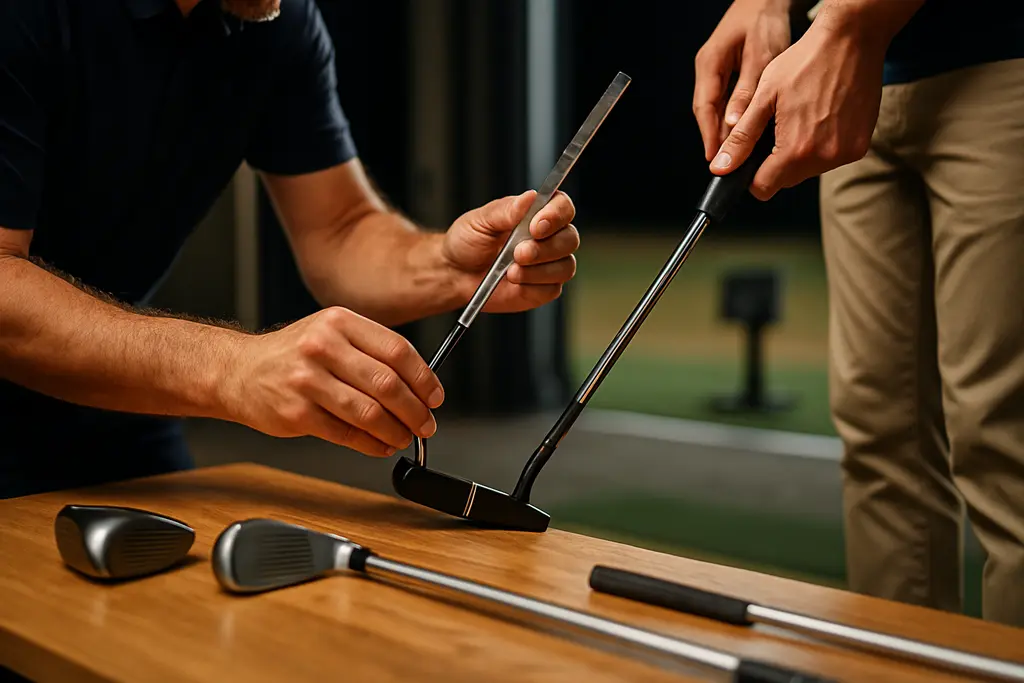
putter shaft innovations reached a notable marker on September 10, 2026, when Graphite Design announced its first-ever putter shaft, the Graphite Design x L.A.B. Golf Tour AD RAIL. As of October 15, 2026, that launch is no longer pending; the shaft has been released and is available. The build story is straightforward but meaningful: Graphite Design brought carbon-fiber shaft engineering, while L.A.B. Golf brought a putter platform built around stability, torque management, and feel.
For a fitter, the interesting part is not the brand pairing by itself. It is how the RAIL gives golfers another high-end putter shaft option inside L.A.B.’s system. A putter shaft does not create a stroke on its own, and no shaft should be treated as an automatic cure for start-line, speed, or face-control issues. But shaft weight, stiffness, bend feel, and feedback can change how a golfer senses the head during a stroke. That is why this collaboration belongs in the build-and-materials conversation rather than the hype bin.
Why Putter Shaft Innovations Matter In Fitting
The Tour AD RAIL was announced as a co-developed Graphite Design and L.A.B. Golf shaft, built specifically for L.A.B. putters. The release coverage stated that the shaft is manufactured in Chichibu, Japan, at Graphite Design’s headquarters, and that the goal was high stiffness and stability without losing feel Graphite Design announcement. That matters because putter shafts are no longer just plain steel tubes chosen after the head is selected.
Putter Shaft Innovations And Feel
In a fitting bay, putter shaft innovations should be judged through the player’s delivery, not through material language alone. A very stiff putter shaft can feel clean to one golfer and too firm to another. A softer-feeling shaft may help one player sense tempo, while another may lose awareness of the head. The useful question is not whether graphite is “better” than steel. The useful question is whether the shaft helps the player repeat setup, stroke length, face presentation, and speed control.
L.A.B. Golf’s own shaft page describes the Tour AD RAIL as using ultra-high modulus 50-ton carbon fiber and says it delivers the highest CPM and lowest deflection in L.A.B.’s lineup, with exceptionally keen feel and feedback L.A.B. shaft options. CPM stands for cycles per minute, a common shaft-frequency measurement. Lower deflection refers to reduced bending under load. Those descriptions point to a very stable profile, but they do not replace a fitting session.
Why Stability Still Needs A Player Match
L.A.B. Golf’s larger design platform is Lie Angle Balanced putting. The research notes describe that system as balancing the putter so the shaft is aligned with the center of gravity, reducing torque and helping the face stay square through the stroke. That makes shaft selection more sensitive than it may appear. If the head is engineered around face stability, the shaft becomes part of the golfer’s feel system: how heavy the build feels, how the head returns, and how impact feedback reaches the hands.
This is also where the word “upgrade” needs care. A $399 shaft option can be a rational fit for some golfers and an unnecessary spend for others. The right test is not price or prestige. It is whether the build produces better roll quality, distance control, comfort, and start-line consistency during a real comparison against the player’s current shaft or a standard L.A.B. option.
Tour AD RAIL Build Details
The known build details are clear enough to guide a fitting conversation without stretching the claims. The Tour AD RAIL is offered in Standard and Counterbalanced styles. Standard length options are 28 inches to 38 inches, while Counterbalanced length options are 36 inches to 40 inches. The listed uncut short weight is 150 grams. L.A.B. also lists the shaft at US$399.
- Model: Graphite Design x L.A.B. Golf Tour AD RAIL.
- Material: ultra-high modulus 50-ton carbon fiber.
- Styles: Standard and Counterbalanced.
- Lengths: 28–38 inches for Standard; 36–40 inches for Counterbalanced.
- Listed weight: 150 grams uncut short.
- Listed price: US$399.
Standard Versus Counterbalanced Builds
The Standard and Counterbalanced split is important. A standard-length build may suit players who prefer familiar setup posture, conventional hand placement, and a more direct sense of head movement. A counterbalanced build can change the way weight is felt in the hands and through the stroke. That does not make one style universally better. It gives the fitter two different ways to manage feel, balance, and stroke timing.
Because the RAIL is offered in longer counterbalanced lengths, the fitting should include posture, hand height, lie angle, and grip choice. A shaft with low deflection may still feel wrong if the total build weight or grip weight pushes the player into a tense setup. The shaft is only one part of the putter, but on a stable-head platform it can be the part that decides whether the golfer trusts the build.
Carbon Fiber As A Design Tool
Graphite Design is known for carbon-fiber shaft engineering, and this shaft extends that work into the putter category. The research notes also place the RAIL alongside other L.A.B. upgrade options, including Diamana Matte x L.A.B. Golf, GEARS x L.A.B. Golf, ACCRA x L.A.B. Golf, and the earlier TPT option. Those examples show that L.A.B. has treated putter shafts as an active fitting category rather than a cosmetic accessory.
That is the key lesson for golfers comparing options. Carbon fiber can be used for stiffness, feel, weight placement, and feedback. It is not one single sensation. A high-modulus shaft designed for low deflection will not feel the same as a shaft built around a softer response. Golfers who have tested graphite in woods or irons already know that labels can mislead if the player does not test the actual build. The same caution applies here, and readers comparing shaft categories may find this related fitting discussion on graphite shafts for male golfers useful.
Fitting Putter Shaft Innovations Without Guesswork

A sound putter fitting starts with the golfer, not the newest shaft. The fitter should watch setup, aim tendencies, stroke shape, tempo, face angle behavior, launch, roll, and speed control. From there, the shaft choice can be tested as part of a complete putter build. In that setting, putter shaft innovations such as the Tour AD RAIL can be judged by what the golfer can repeat.
What To Test Before Choosing RAIL
The first check is comfort at address. If the player fights the setup, no material story will save the build. The second check is distance control across short, mid-range, and longer putts. A shaft that feels stable but makes the player hit everything past the hole may not fit that player. The third check is start line. If the golfer starts more putts on line with a different shaft, that evidence should carry more weight than any spec sheet.
Feedback is another part of the test. Some golfers want a crisp strike sensation. Others need a little more softness to avoid steering the putter. Since L.A.B. describes the RAIL as having keen feel and feedback, it is worth testing against L.A.B.’s other graphite options where possible. The comparison should be done with the same head model and similar build conditions, or the shaft result can get mixed with head, grip, length, or lie changes.
For broader sports and equipment reading from a related site in the same network, readers might find AP Levante to be an insightful resource alongside this type of gear-focused coverage. For putter fitting itself, though, the best evidence remains the player’s actual roll pattern and comfort with the build.
Graphite Design And L.A.B. Golf Tour AD RAIL
The Graphite Design x L.A.B. Golf Tour AD RAIL is a real step in the premium putter shaft category because it brings a major graphite shaft maker into a purpose-built L.A.B. putting application. It uses ultra-high modulus 50-ton carbon fiber, comes in Standard and Counterbalanced styles, and sits at the top of L.A.B.’s stated stiffness and low-deflection range.
The practical read is simple: this shaft is worth testing for golfers already interested in a L.A.B. build who want a firmer, highly stable feel profile. It should not be selected only because it is new, expensive, or co-branded. The best fit is the one that helps the golfer aim, start the ball, manage speed, and stay comfortable under pressure. In that sense, putter shaft innovations are useful only when they survive a proper fitting.