
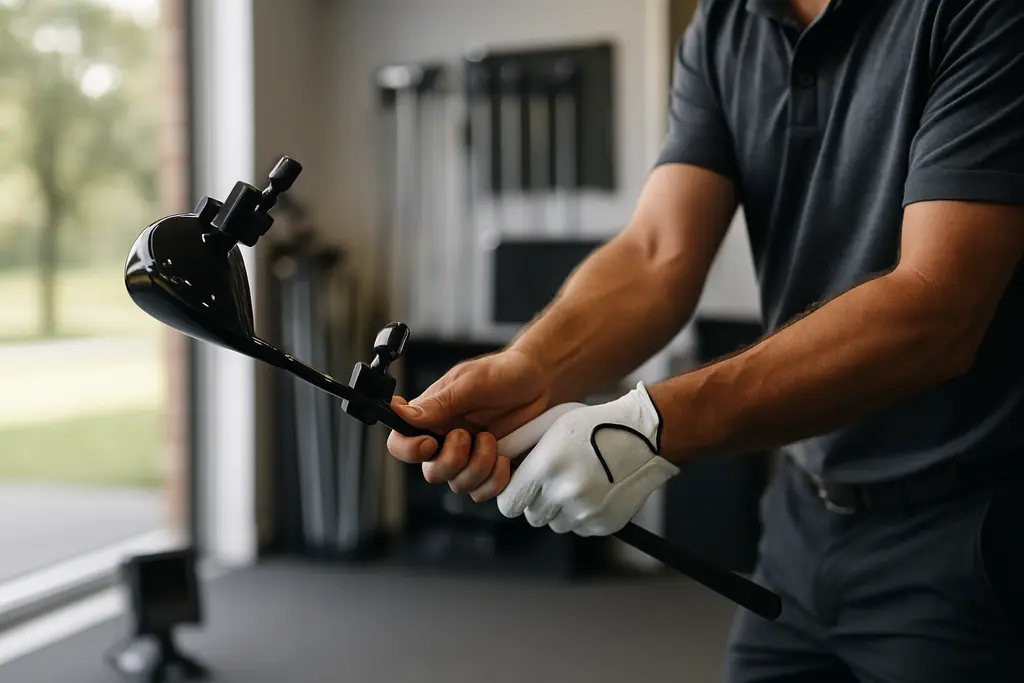
biomechanics driver fitting became a clearer fitting topic on October 5, 2026, when TaylorMade announced a strategic partnership with Sportsbox AI to bring markerless 3D motion analysis into its MyFittingExp™ system. For golfers booking a driver fitting, the point is not that movement data replaces the launch monitor. The point is that a fitter can now compare what the ball did with how the player moved to create it.
That matters because driver fitting can become too result-only if the session is built around ball speed, launch angle, spin, carry, and dispersion without enough context. Those numbers are still central. A driver head and shaft have to work in the real ball flight. But if two players create similar launch numbers through very different movement patterns, the same product answer may not be equally stable for both players.
TaylorMade said the enhanced MyFittingExp system combines traditional launch monitor data with Sportsbox AI’s single-camera, AI-powered biomechanics so fitters can observe swing movement as part of the fitting decision. The company also said green-grass fitting locations began getting access on October 12, 2026, with retail fitting locations planned later in 2026, according to the TaylorMade announcement.
What Biomechanics Driver Fitting Adds
The useful word here is context. Launch-monitor data tells the fitter what happened at impact and in flight. Motion capture can help explain why it happened, or at least point the fitter toward movement patterns worth checking. A player who fights a low-left miss, for example, may not need the same fitting path as a player who delivers too much dynamic loft and spin, even if both players say they want a more reliable driver.
Why Biomechanics Driver Fitting Needs Launch Data
biomechanics driver fitting should not be treated as a replacement for ball-flight testing. A driver fitting still has to answer basic performance questions: Where is the strike pattern? Is launch in a playable window? Is spin helping the ball stay in the air or making it balloon? Is the player’s miss pattern tighter, wider, higher, lower, left, or right?
Motion data helps when it is tied back to those questions. If a fitter sees that a player’s rotation pattern matches better with a certain shaft profile or driver head setup, the launch monitor still has to confirm that the recommendation works under real swings. One great shot does not prove a fit. One poor swing should not throw out a good option. The value is in a set of swings that shows a pattern.
What Markerless Capture Changes
Sportsbox AI’s system is described as markerless, meaning the golfer does not need physical sensors, markers, or wearable devices during capture. The system uses a single smartphone camera to generate a three-dimensional biomechanical model of the golfer’s movement. For an appointment setting, that can reduce friction. The golfer can swing normally, the fitter can collect movement data, and the session does not have to turn into a lab test.
For most golfers, that is the practical win. The less the technology changes the golfer’s routine, the more useful the session can be. A fitting bay already asks players to perform under observation, often with unfamiliar heads and shafts. If the motion capture stays out of the way, the fitter has a better chance to evaluate the swing the player actually brings to the course.
How TaylorMade And Sportsbox AI Fit Together
TaylorMade’s MyFittingExp system is the platform side of the process. Sportsbox AI supplies the markerless motion analysis. Together, the setup is meant to give the fitter both the ball-flight result and the body-motion context behind it. That is a meaningful shift for appointments where the player’s delivery pattern changes from one shaft or head to another.
MyFittingExp Timing And Booking
According to the research available from TaylorMade’s announcement, MyFittingExp with Sportsbox AI began at green-grass fitting locations on October 12, 2026. TaylorMade planned retail fitting availability later in 2026. That means golfers should not assume every fitting site has the same version of the system on the same date. Before booking, ask whether the specific location is using the enhanced MyFittingExp process with Sportsbox AI.
The booking experience is managed through the MyFittingExp app, where golfers can schedule appointments at participating TaylorMade fitting sites and review fitting information after the session, including launch monitor data and recommended heads and shafts. For insights on how similar services operate within the network, check out Copeland Hills Golf, a related site.
REAX Rotation Profiles
A central fitting element in TaylorMade’s 2026 system is REAX, which classifies golfers into three club-head rotation profiles: REAX HR for High Rotation in red, REAX MR for Mid Rotation in blue, and REAX LR for Low Rotation in white. TaylorMade says the system is based on years of research and millions of swings analyzed.
From a fitting standpoint, the profile should be treated as a starting point, not a magic answer. A rotation category can help the fitter choose which head and shaft combinations deserve testing first. It does not remove the need to watch strike, start direction, curvature, launch, spin, and how the golfer reacts to the club. Good fitting is still a conversation between data, club build, and player feedback.
What Golfers Should Ask Before Booking
A more data-rich session can be valuable, but only if the golfer knows what to ask. The best appointments usually start with a clear problem: too much spin, weak flight, two-way miss, poor strike location, poor confidence with driver, or a driver that worked in the past but no longer fits the swing. The fitter can then use motion and launch data to test the right variables.
Bring Your Normal Driver And Normal Swing
Do not arrive trying to manufacture a fitting-bay swing. Bring your current driver if possible, hit it early in the session, and let the fitter see the baseline. The current club gives the numbers a reference point: ball speed, launch, spin, carry, total pattern, face contact, and dispersion. It also shows whether the problem is mainly equipment, delivery, or a mix of both.
With biomechanics driver fitting, the baseline matters even more because the fitter is not only comparing club output. The fitter is also watching how the player’s movement pattern interacts with different builds. A shaft that looks good for three swings but changes the player’s timing in a bad way may not be the right long-term fit.
Read The Data Without Chasing One Number
Golfers often walk into driver fittings wanting more ball speed or lower spin. Those can be valid goals, but they are not enough by themselves. A driver that produces a slightly faster best shot but a much wider miss pattern may not help on the course. A higher-launching setup that keeps the ball in play more often may be a better fit for some players, even if it does not win the single-swing contest.
- Ask which launch-monitor metrics drove the recommendation.
- Ask how the Sportsbox AI motion data affected the head or shaft choice.
- Ask whether your REAX profile changed the testing order.
- Ask how the recommended setup compares with your current driver across several swings.
- Ask what trade-offs you should expect, such as launch, spin, feel, or shot shape.
For a deeper read on how to avoid overreacting to isolated numbers, see this guide to fitting metrics that make club fitting clear. The same principle applies here: the best data is the data that helps a golfer and fitter make a better decision.
How This Compares With Earlier Motion-Based Fitting
Sportsbox AI was not new to golf fitting before the TaylorMade announcement. The company had already been used by coaches and club fitters, and TaylorMade said Sportsbox AI was in use on all major professional golf tours. The TaylorMade partnership matters because it connects that motion technology to a major manufacturer’s driver fitting workflow.
There was also an earlier equipment precedent. In 2023, LA Golf partnered with Sportsbox AI on a motion-based club fitting experience. Sports Business Journal reported that users in that program gained an average of 9 yards in driving distance and reduced shot dispersion by 15 yards through LA Golf’s Fit Yourself Experience with Sportsbox AI, according to Sports Business Journal.
Those LA Golf figures should not be copied onto TaylorMade’s system as a promise. Different products, different golfers, different fitters, and different test conditions can lead to different outcomes. The lesson is narrower and more useful: motion-based fitting has already been applied in a commercial fitting setting, and manufacturers are showing more interest in how movement data can guide equipment choices.
Biomechanics Driver Fitting In Real Appointments
biomechanics driver fitting is best understood as a fitter’s tool, not a shortcut around the fitting process. The golfer still has to hit enough shots to create a fair sample. The fitter still has to test head and shaft combinations in a logical order. The final recommendation still has to survive the basic questions: does it launch properly, spin properly, start on a playable line, and keep the miss pattern manageable?
The TaylorMade and Sportsbox AI partnership gives participating fitters another layer of information. That can be useful for players who struggle to describe what they feel in the swing, players whose driver delivery changes with different shafts, and players who need a more objective read on why one setup performs better than another.
For golfers booking a TaylorMade driver fitting after October 12, 2026, the practical move is simple: confirm whether the location has the enhanced MyFittingExp system, bring your current driver, and ask the fitter to explain how the motion data and launch data worked together. biomechanics driver fitting will not guarantee a better scorecard or a longer drive. Used well, it can make the fitting conversation more specific, more testable, and more connected to the swing you actually take to the course.