

Golf club fitting has undergone a significant transformation with the advent of advanced technology. Modern club fitting is no longer guesswork; it’s driven by data analysis and precise measurements.
Using tools like launch monitors and swing analyzers, professional club fitters can collect detailed information about a golfer’s game. This data-driven approach enables fitters to make informed decisions, leading to improved accuracy and distance for golfers.
By leveraging technology, golfers can gain a deeper understanding of their swing mechanics and ball flight characteristics. This insight allows for more precise club fitting, resulting in better performance on the course.
How Data Informs Decisions
The use of advanced technology, such as Trackman, has transformed the golf club fitting process. By analyzing various metrics, fitters can now make data-driven decisions to optimize a golfer’s equipment.
The Science Behind Club Fitting
Trackman measures various parameters such as swing speed, ball speed, launch angle, spin rate, club path, and face angle. These metrics provide a comprehensive understanding of a golfer’s swing and help fitters identify areas for improvement.
For instance, data on launch angle and spin rate can help determine the optimal loft and shaft specifications for a golfer’s driver. A golfer with a high swing speed may require a different shaft flex than one with a slower swing speed.
| Swing Speed | Recommended Shaft Flex | Optimal Loft |
|---|---|---|
| High (>90 mph) | Stiff/X-Stiff | 9-10° |
| Medium (70-89 mph) | Regular/Stiff | 10-12° |
| Low (<70 mph) | Flexible/Regular | 12-14° |
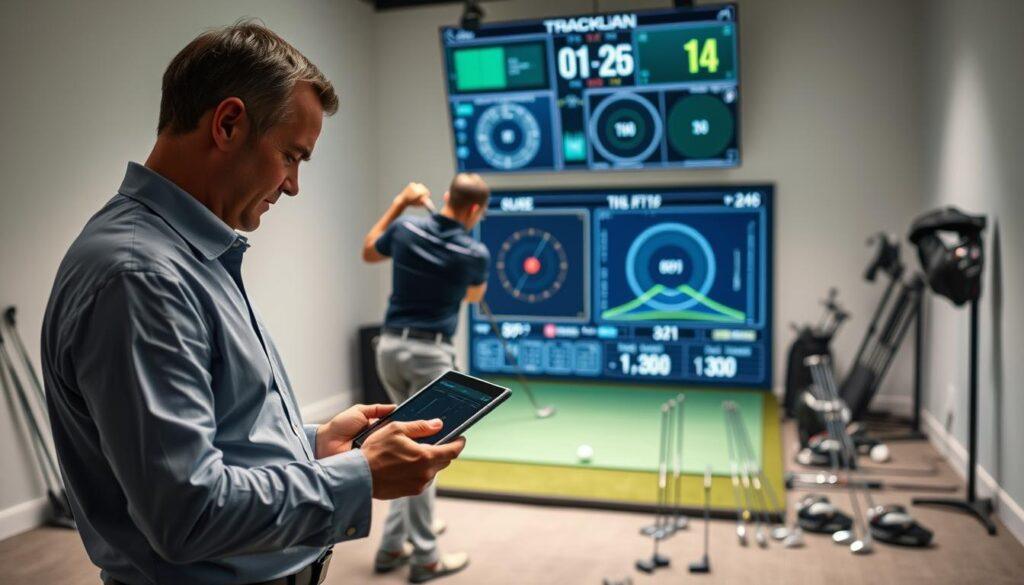
By leveraging data from Trackman, golfers can achieve a more consistent and improved game. The precision offered by this technology ensures that club specifications are tailored to the individual’s swing, enhancing overall performance.
Screenshots & Real Session Results
The true value of technology in golf club fitting is realized when data is translated into actionable insights that improve a golfer’s performance. By examining real session results and screenshots from technologies like TrackMan, golfers and fitters can see firsthand how data informs the fitting process.
Putting Data into Action
Experienced fitters like Tom Davies emphasize the importance of balancing technology with the golfer’s experience. Davies notes that controlling the flow of information is crucial, as “more data doesn’t equal better fittings.” This approach highlights the need to trust the golfer’s feel while using technology to refine the fitting process.
Real-World Examples
For instance, a fitter might use TrackMan data to adjust a golfer’s club loft and shaft length, resulting in improved accuracy and distance. By combining technological insights with practical experience, golfers can enjoy a more personalized and effective fitting process, ultimately enhancing their overall performance.