

Launch monitor days can be useful for golfers who want more than a quick demo swing and a sales pitch. The idea is simple: bring your current clubs, bring a personal launch monitor if the shop allows it, and use the event to compare baseline numbers against fitting options in a fair setting. The caution is just as simple. A local event is not automatically a full bag fitting, and a personal device is not automatically equal to the fitter’s system. The value comes from asking better questions and keeping the comparison honest.
Custom fitting is no longer a niche service for low-handicap players. MyGolfSpy’s 2024 fitting survey reported that about 49 percent of fittings in its respondent group used either TrackMan or FlightScope, which tells us that launch data has become a normal part of the buying conversation, not a luxury add-on MyGolfSpy fitting survey. That does not mean every session is equal. The monitor, the hitting environment, the ball, the shaft matrix, the fitter’s process, and your swing behavior all shape the answer.
What Launch Monitor Days Can Really Tell You
A bring-your-own format works best when you treat it as a comparison session, not a contest to hit the longest shot of the day. Your personal monitor can give you a second reference point, while the shop or brand fitter may use a higher-end radar or camera-based unit. The point is not to argue over every yard. The point is to see whether the direction of the data agrees.
Launch Monitor Days Start With A Baseline
The first job is to measure the clubs already in your bag. Hit your gamer driver before the demo head. Hit your current 7-iron before the new model. If you are testing wedges, hit shots at normal scoring distances rather than full-swing only. Without that baseline, you are left comparing a fresh club on a good swing against a memory of what your old club usually does.
The value of launch monitor days is that they make the baseline visible. Ball speed, club speed, smash factor, launch angle, spin rate, spin axis, and carry distance are all useful comparison points when they are captured consistently. Carry distance matters more than a single total-distance number, especially indoors or on firm range turf. Spin rate and launch angle tell you why the ball is flying the way it is. Spin axis and start direction help explain curvature. Smash factor can expose strike quality, but it should not be read in isolation.
Do Not Chase The Hero Swing
Most poor fitting decisions start with a swing that the player cannot repeat on the course. If you normally swing a driver at controlled speed, do not suddenly try to hit every ball at maximum speed because a fitter, a brand rep, or a friend is watching. If you usually play a fade, do not spend the session trying to manufacture a draw unless that is part of a clear testing plan.
A useful fitting event captures your real pattern: solid shots, slight misses, and the occasional poor strike. A head-and-shaft combination that looks perfect only when you catch one out of ten swings is not a strong fit. A club that keeps your playable misses tighter may be more useful, even if the single longest shot is not as impressive.
How To Prepare Before The Event
Preparation decides how much you get from a short appointment. Many local fitting events run on fixed time blocks, especially when a manufacturer rep is working through a schedule. Burke Lake Golf Center, for example, hosted a Callaway Performance Club Fitting Day on March 28, 2026, from 10 a.m. to 2 p.m., with factory fitters using launch monitor tools Burke Lake fitting day. That event has already passed as of September 14, 2026, but it is a good example of the appointment-based format golfers should expect at local facilities.
Before you book, ask whether personal launch monitors are allowed in the hitting area. Some facilities may welcome them, some may restrict placement for safety or space reasons, and some may only allow the fitter’s equipment during a brand session. The research on formal bring-your-own policies is thin, so do not assume the shop has a standing rule. Confirm it directly.
- Bring your current clubs for direct comparison, not just the club you hope to replace.
- Use the same golf ball type where possible so spin and launch comparisons are cleaner.
- Ask which metrics will be shown and whether you can review the session data afterward.
- Tell the fitter about your normal ball flight, common miss, course conditions, and preferred shot shape.
- Clarify whether any fitting fee is credited toward a club order before the session starts.
If you want a deeper primer on the numbers before you arrive, our piece on fitting metrics explains how launch, spin, carry, and dispersion work together. For wider sports venue and event coverage across the same network, Sports Wire News provides insights into related sports scheduling and facility stories.
Reading The Data Without Overreacting
Golfers often get too attached to one column on the screen. Driver shoppers stare at total distance. Iron shoppers stare at carry distance. Wedge shoppers may not look beyond spin. A better fitting conversation asks what changed, why it changed, and whether that change fits your course needs.
Radar And Camera Units Can Disagree
TrackMan and FlightScope are radar-based systems. Foresight GCQuad and GC3 are camera-based systems. Both categories can be useful, but they do not always read every shot the same way, especially if the environment, ball flight length, lighting, or setup varies. A personal monitor may also report fewer data points than a fitter’s unit. That is not a reason to throw out the session. It is a reason to compare trends rather than obsess over tiny differences.
If your device says the new driver launched higher with less spin, and the fitter’s unit shows the same trend, that is meaningful. If one unit shows a huge gain and the other does not, slow down. Ask about normalization settings, target alignment, ball type, tee height, and whether the shot set included enough swings to trust.
Dispersion Matters More Than A Single Best Shot
A fitting event should help you understand your pattern. Ten driver shots that average a playable window are more useful than one perfect strike and nine shots that would miss a fairway by a wide margin. With irons, look at carry gaps and front-to-back spread. A 7-iron that flies farther but produces inconsistent spin may create more trouble into greens. With wedges, partial-shot control and predictable launch may matter more than full-swing yardage.
This is where your personal device can help keep the session grounded. If you have used it during practice, you may already know your normal carry windows. Bring those expectations, but stay open to the fitter’s better tools and experience. The right question is not, “Which monitor is correct?” It is, “Do the results describe the shots I actually play?”
Indoor And Outdoor Fitting Trade-Offs
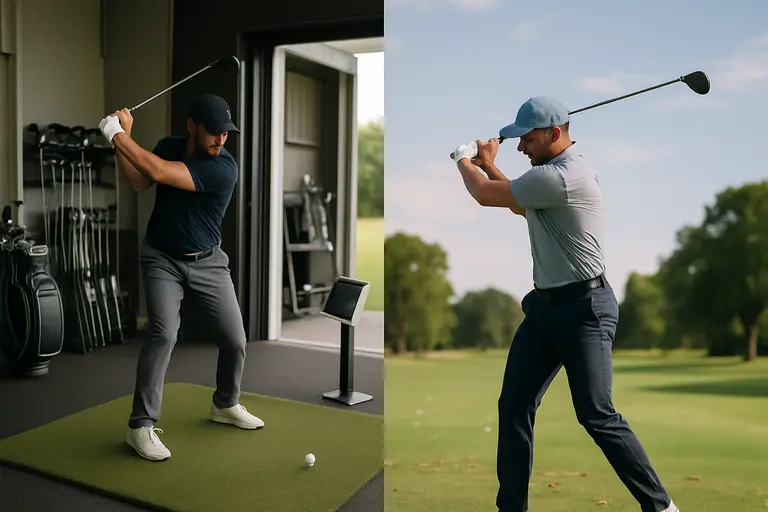
Indoor hitting bays offer controlled conditions. Wind, temperature swings, turf moisture, and range-ball variation are reduced or removed. That makes equipment comparisons cleaner. Outdoor settings let you see ball flight, turf interaction, trajectory shape, and landing behavior. Neither setting is perfect.
For irons and wedges, turf interaction deserves attention. A club that looks excellent off a mat may not enter and exit real turf the same way. Sole width, bounce, and leading-edge behavior can affect strike quality, especially for players who take a divot. For drivers and fairway woods, seeing real ball flight can help a golfer connect launch monitor numbers to visual confidence.
If the event is indoors, ask how the fitter accounts for total distance and descent. If it is outdoors, ask what ball is being used and whether the launch monitor is set up with enough flight to capture reliable data. If you bring your own monitor, place it only where the facility permits. Safety and the fitter’s workflow come first.
Questions Worth Asking The Fitter
A local event moves quickly, so clear questions matter. You are not being difficult by asking for context. Good fitters usually prefer an informed golfer because it keeps the conversation focused on performance rather than guesswork.
- What is my current club doing well, and where is it costing me?
- Are we solving launch, spin, strike location, direction, or gapping?
- How many swings are enough before we compare one option to another?
- Did the best result come from the clubhead, shaft, loft setting, lie angle, length, or a mix of factors?
- Would this build still make sense if I am not swinging my best?
Those questions keep the session practical. A shaft that times well for five swings may not be the answer if length, lie, or loft is the real issue. A new head may not help if the current driver is poorly adjusted. A stronger iron may add carry but widen gaps at the top or bottom of the set. The aim is not to buy more club than you need. The aim is to understand what the data supports.
Launch Monitor Days Done The Right Way
Treat launch monitor days as a structured test. Start with your current club, control the ball and setup variables, swing normally, and compare shot patterns rather than isolated best shots. If the fitter’s system and your personal monitor agree on the main trend, you have stronger evidence. If they disagree, ask why before making a decision.
A bring-your-own session will not replace every part of a full fitting. It can, however, help you spot questionable claims, understand your baseline, and leave a local shop with better notes. The best outcome is not a promised score drop or a guaranteed distance jump. It is a clearer view of which equipment changes are supported by repeatable data and which ones need more testing before they belong in your bag.