

Let’s face it: your scoring clubs might be tricking you. They look great in your bag, but they’re secretly making your game harder.
We spend a lot of time on driver launch angles, like NASA engineers. But for our wedges, we often just pick what looks good. It’s like racing with the wrong tires.
Studies show we use wedges for about a quarter of our shots. And, two-thirds of all golf shots are from 125 yards or less. Doing well here can really lower your score.
This isn’t about buying new clubs. It’s about understanding your game better. We’ll look at how you play around local greens and find a setup that works for you. Get ready to learn about the short game’s geometry, physics, and psychology.
Assessing Current Gaps & Launch Monitor Testing
You wouldn’t guess about a car engine by listening to the radio. So why guess about your wedge gaps? The first step is to check your current setup closely. This is a detailed check, not a casual talk.
Looking for signs of wear on your wedges is key. A pattern on the toe or heel shows where you often miss. Loft creep is also a clue. Over time, your clubs can lose loft, affecting your game.
Start by checking your clubs yourself or with a fitter. This helps understand your swing better. It prepares you for the next step: using a launch monitor.
The launch monitor is like an unbiased judge. You need a good simulator or a range with a monitor. The goal is to find out why your game isn’t perfect.
Launch monitors show the truth about your game. They reveal if you have a big gap between clubs. They also check if you’re stopping the ball right. This is where true spin control is shown, not just guessed.
The table below shows what a revealing session looks like. It compares key metrics for three wedges. It highlights gaps and spin issues that affect your game but can be fixed.
| Club (Loft) | Carry Distance (yds) | Spin Rate (rpm) | Peak Height (ft) | Gap to Next Wedge |
|---|---|---|---|---|
| Pitching Wedge (46°) | 118 | 5,200 | 90 | +22 yds |
| Gap Wedge (50°) | 96 | 6,800 | 98 | +18 yds |
| Sand Wedge (56°) | 78 | 8,500 | 105 | N/A |
See the problem? A 22-yard gap is a big difference in the short game. The spin jump shows how much it affects the ball’s behavior. This data guides you.
This process is at the heart of our fitting philosophy. It turns vague complaints into a clear plan for improvement. You stop blaming yourself and learn what’s really going on.
With this knowledge, we can talk about real solutions. We’re not just discussing feelings anymore. We’re working on fixing your game based on your unique needs. The launch monitor shows us the truth.
Bounce & Grind by Turf/Sand Types in PA
In Pennsylvania golf, your wedge’s bounce is key. It’s like a deal with the ground. Will it glide smoothly or fight the turf?
The number on the sole is just the start. Effective Bounce is what really matters. It’s how much of the sole touches the ground, based on angle, width, and shape.
Why is this important? Different swings need different clubs. A steep swing on soft turf needs a special club. A shallow swing on hard ground needs another.
| Effective Bounce Category | Range (Sq. Inches) | Ideal Player Profile | Common PA Turf Match |
|---|---|---|---|
| Normal | 0.101 – 0.150 | The neutral swinger. Not too steep, not too shallow. A true “Goldilocks” golfer. | Well-maintained parkland courses in spring/fall. Average bunker sand. |
| Increased | 0.151 – 0.200 | The moderate digger. Takes a slightly deeper divot. Likes to feel the turf. | Lush, rain-softened fairways. Fluffy, deeper bunkers. |
| Greater | 0.201 – 0.312 | The committed excavator. A negative attack angle is their signature move. | Very soft conditions, wet rough, or ultra-light sand. |
| Maximum | 0.312+ | The ultimate turf-skimming glider. Picks the ball clean with a shallow brush. | Firm, tight lies of late summer. Hard, compacted “concrete” bunkers. |
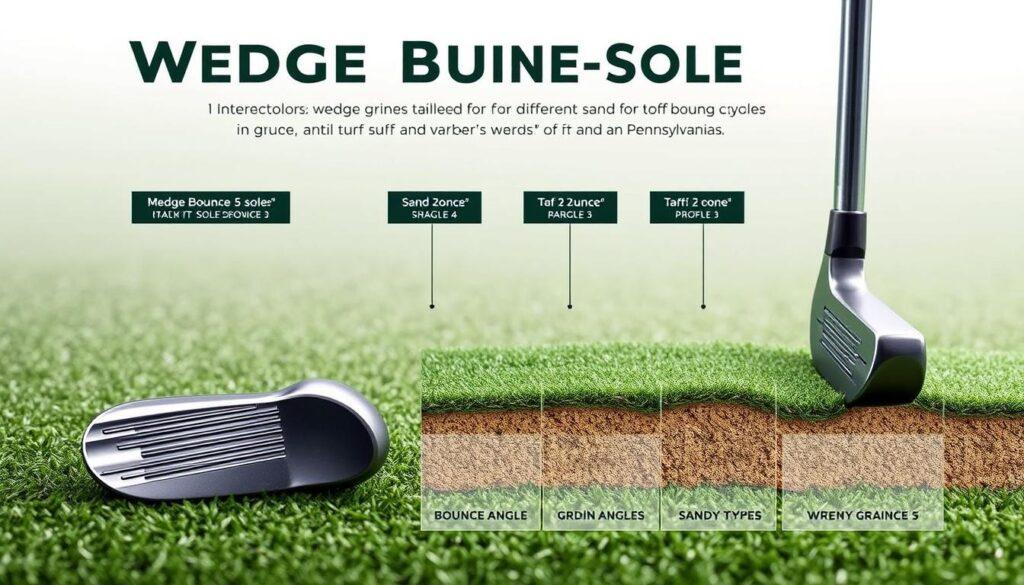
Low Bounce Wedges (4-6 degrees) are for those who like to sweep the ball. They’re great on hard ground but not in soft areas. In PA, they’re best in August.
Mid Bounce Wedges (7-10 degrees) are all-rounders. They’re like a reliable SUV. They handle most conditions well.
High Bounce Wedges (10+ degrees) are for soft turf and sand. They’re your friend after a spring storm or in easy bunkers.
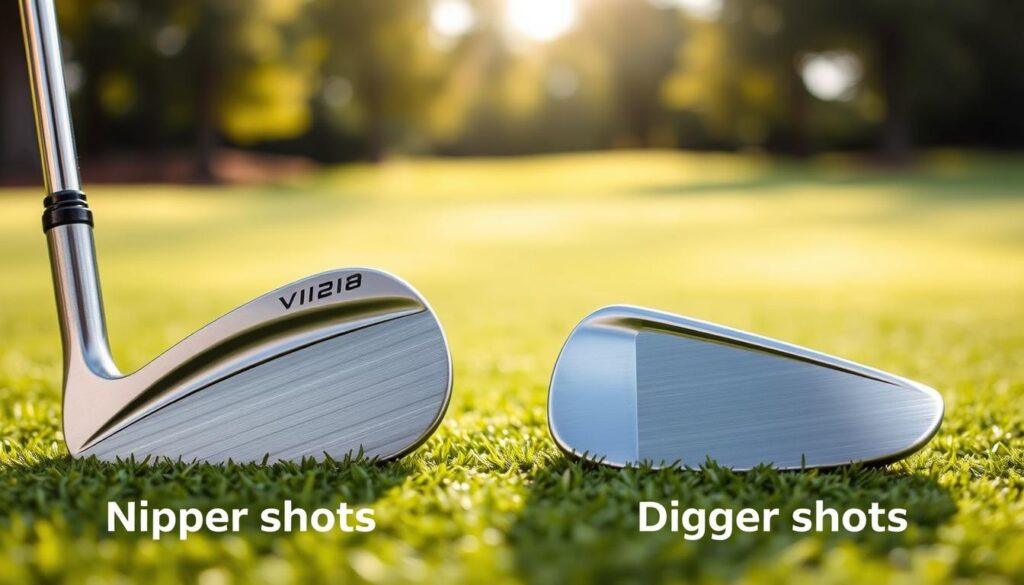
Are you a nipper or a digger? Your swing decides. A steep swing needs more bounce to avoid digging. A shallow swing needs less to avoid bouncing the ball.
Pennsylvania’s golf is varied. It’s soft one day and hard the next. Your wedge setup must match these conditions.
This is how we move from “I play a 56-degree” to “I play a 56-degree with a wide sole, a C-grind, and ~0.220 square inches of effective bounce for my steep attack on typically soft turf.” That’s the difference between having a wedge and having a weapon for Pennsylvania.
Shot Types: Nippers vs. Diggers
Think of your wedge sole as a tool. For Diggers, it’s like a shovel. For Nippers, it’s a scalpel. Using the wrong one is a big mistake. Your swing style decides everything.
Are you the kind who takes a big divot, or do you just skim the grass? It’s not about being good or bad. It’s about physics.
The Digger has a steep, aggressive swing. On soft turf, it feels like chopping wet clay. The Nipper has a shallow swing. This is better on firm turf but can slide under the ball on soft grass.
The grind is like custom tailoring for your swing. It’s shaping the wedge’s sole. This changes how it interacts with the turf.
Manufacturers offer many grind options. Each is for a specific job. Choosing the right one lets you play more shots, not fewer.
Let’s look at common sole grinds and who they’re for:
| Grind | Best For | Bounce Profile | Key Feature |
|---|---|---|---|
| F Grind | Full shots, traditionalists | Full, consistent bounce | Reliable on full swings, less versatile around greens |
| S Grind | All-around players, varied conditions | Standard, moderate bounce | The “stock” option, good for most amateurs |
| M Grind | The creative shot-maker | Moderate bounce with heel/toe relief | The Swiss Army knife. Opens up for flops, closes for runners. |
| D Grind | The Digger’s best friend | High bounce with trailing edge relief | Prevents digging in soft turf but allows for open-face shots. |
| K Grind | Bunker struggles, game improvers | Extremely high, wide bounce | The ultimate sand savior. Glides through bunkers, forgives on fat chips. |
| L Grind | The Nipper or firm conditions | Very low bounce | Minimal sole interaction. Perfect for tight lies, hardpan, and pickers. |
| U Grind | Ultimate versatility, skilled players | Variable, with significant relief | Maximum creativity. Demands skill but offers every shot shape. |
Using a low-bounce L-grind on soft turf is like asking the club to dig. A high-bounce K-grind won’t work well on tight lies. The wrong grind can hurt your score.
The right grind opens up new shot-making possibilities. The M Grind is great for soft flops and checking pitches. The D Grind gives forgiveness but also allows for open-face shots. It turns a limitation into a strategy.
So, what’s your swing style? What does your course demand? Your answers will guide you to the right grind. The right grind doesn’t just add a wedge. It adds a new dimension to your game around the greens.
3‑ or 4‑Wedge Matrix
Your short game success depends on solving a simple math problem called wedge gapping. This is key. It’s the difference between a confident swing and an awkward one that misses the mark.
The “Pitching Wedge and Sand Wedge” duo is outdated. Modern lofts have changed the game. Your 44-degree pitching wedge is like a 9-iron in disguise. This creates a big gap to a traditional 56-degree sand wedge. You can’t manage what you don’t measure, and wedge gapping is pure math.
We build your matrix from the green backward. Start with your highest loft, like a 58 or 60-degree lob wedge. This is your go-to for tight lies. Then, fill in the gaps with each club.
The golden rule? Keep loft gaps to around 4 degrees. This creates consistent 10-15 yard distance gaps. So, from your 60-degree LW, add a 56-degree SW, then a 52-degree gap wedge, and your 48-degree PW. That’s a clean, 4-wedge system.
But do you need three wedges or four? The answer is in your how many wedges you need based on your distances. Consider these two factors:
- Full-Shot Distances: Does a 4-degree loft change give you a distinct, usable yardage?
- Partial Swing Comfort: Are you confident hitting a 3/4 swing with your gap wedge, or do you need a dedicated club for that exact yardage?
Let’s run the numbers. If your 9-iron is 40 degrees and your PW is 44, you already have a tight gap. Adding a 48, 52, 56, and 60 might be overkill. A 3-wedge system of PW (44), GW (50), and SW (56) might be perfect. Your launch monitor data from earlier is the only honest guide here.
The goal is a progression where each club has a clear, distinct yardage. No more guessing between a hard gap wedge and a soft pitching wedge. This matrix is your short-game playbook. It turns a complex finesse shot into a simple, arithmetic decision.
Maintenance & Loft Checks Booking
So you’ve built your Sage-approved wedge matrix. Now comes the unsexy part: maintenance. Think of it like a sports car. You can have the perfect engine, but skip the oil changes and watch it sputter.
Your grooves are your tire tread. They grab the ball for spin control. Over time, that razor edge wears into a dull butter knife. It shears less cover, steals your bite. I want faces milled flat before machining, with a light sandblast. Too much blasting rounds the groove edge, reducing bite. Regular play accelerates this decay.
Lofts and lies drift from repeated impact. That perfect 12-yard gap you engineered? It can silently become a messy 5-yard overlap. Your scoring arsenal turns to guesswork.
This isn’t a one-time purchase. It’s an ongoing relationship. Schedule periodic loft and lie checks. Look for worn grooves, inconsistent flight. When spin control fades, consider regrooving or replacement. Protecting your scoring means keeping your weapons sharp. Book that check-up.