

Graphite Shafts are no longer a quiet corner of the fitting wall reserved only for slower swingers or injury-prone players. For male golfers trying to score better, the smarter question is not whether graphite is “strong enough.” It is whether the shaft helps you deliver the club with repeatable speed, strike, launch, spin, and face control. That answer has to come from a fit, not from ego or a shelf label.
The shift matters because many golfers still treat steel as the default in irons and graphite as an exception. That thinking is getting dated. A PGA Tour equipment report covered C.T. Pan’s move into graphite iron shafts, a sign that serious players are willing to test material changes when performance data and feel line up PGA Tour equipment report. That does not mean every male golfer should switch. It does mean the test deserves a fair session on a launch monitor.
What Graphite Shafts Actually Change
Graphite Shafts And Clubhead Speed
The best starting point is what the research supports. A prospective case series involving 40 right-handed amateur and professional golfers found that graphite shafts produced significantly lower mean muscle activity in the pronator teres and flexor carpi ulnaris muscles of the lead arm during the late follow-through phase. The same study reported a statistically significant increase in clubhead speed for professional golfers using graphite compared with steel, with p=0.011, while carry distance showed no significant difference between materials across the golfer subgroups Springer study.
That last point is useful for fitting. Graphite Shafts did not automatically create more carry in that study, even where clubhead speed changed for professionals. In a bay, that means speed is only one part of the decision. If a lighter or differently balanced build raises speed but also widens face-to-path variation, drops strike quality, or pushes spin outside a playable range, the scoring value may not be there.
Comfort, Load, And Repeatability
Graphite Shafts can feel easier to swing for some players because the build can reduce the physical demand they feel through the hands, wrists, and lead arm. The research above gives a useful clue: lower measured muscle activity in specific lead-arm muscles during late follow-through suggests that material choice can change how the body experiences the swing. That does not diagnose pain, and it does not replace medical guidance. It does give fitters a reason to ask better questions about fatigue during the back nine, practice volume, and whether a player’s strike pattern changes after repeated swings.
For a male golfer getting started with a fitting, comfort should not be dismissed as “soft” data. If the club feels harsh, the player may start steering it. If the shaft feels too light, the player may lose the club at the top. If the balance feels manageable, the player may produce a more stable pattern. The launch monitor will not measure confidence directly, but it will show the results through contact point, dispersion, dynamic loft, and speed consistency.
Launch-Monitor Testing For Graphite Shafts
Build The Test Around The Same Head
A fair comparison starts by controlling as much as possible. The head model, loft, lie, grip size, and playing length should stay consistent if the goal is to isolate the shaft. If the golfer changes the head and shaft at the same time, the data gets noisy. A fitter can still learn from it, but the player should not pretend the shaft alone caused every number on the screen.
Launch-monitor testing should focus on the pattern, not the one best swing. A single high-speed strike can make a shaft look perfect. Ten to fifteen representative swings with each option gives a better read on real golf. The useful questions are simple: Where did the ball start? Did the curve match the player’s intent? Did spin stay playable? Did carry distance hold steady across average swings? Did the worst miss get better, worse, or just different?
Use Scoring Windows, Not Just Distance
For irons, the scorecard often cares more about predictable windows than raw carry. A 7-iron that flies one extra yard on the best strike but creates a wider left-right pattern may not help. A different shaft that keeps carry similar while tightening start line or improving low-point control may be a better scoring tool. That is especially true for players trying to hit more greens, manage front bunkers, and leave uphill putts instead of short-sided chips.
Driver fitting is different, but the same logic applies. A player may see speed change when moving into a lighter profile, but ball speed, launch, spin, impact location, and dispersion decide whether that speed has value. For players who track notes across equipment, practice, and other sports topics, the same network also includes a site called Wikiapp as a simple reference point.
- Carry average: Compare normal strikes, not only the longest ball.
- Dispersion: Track left-right spread and short-long misses.
- Launch and spin: Watch whether the ball can hold greens.
- Strike location: Check whether the contact pattern improves or drifts.
- Fatigue response: Re-test after several swings, not just while fresh.
Build Decisions Male Golfers Should Test
Weight Is Only One Variable
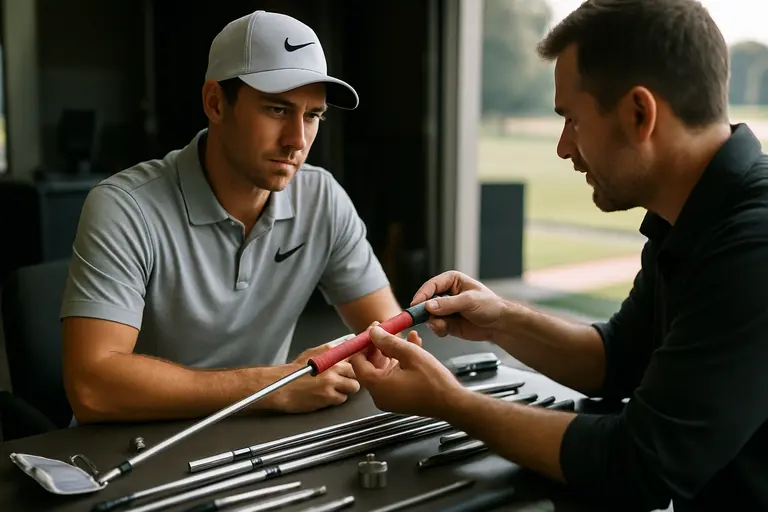
A common mistake is treating graphite as a single category. In real fitting work, the useful question is not “steel or graphite?” It is which total build lets the golfer deliver the club well. Weight, flex, bend profile, torque feel, balance point, playing length, swingweight, and grip can all affect delivery. The player does not need to know every engineering term, but he should know what he feels and what the ball does.
Some male golfers may prefer a graphite iron build that is close to their current steel weight. Others may respond better to a lighter option. Some may need help launching long irons but want a heavier feel in wedges. None of those choices should be made from a stereotype. The fitter’s job is to create a test that answers the player’s scoring problem: more playable height, better strike, less harsh feel, tighter start line, or more usable speed.
Do Not Let Shaft Testing Hide The Short Game
Shaft fit can help a golfer build a more repeatable full swing, but it will not solve every scoring leak. If the main problem is chunked chips, bladed wedges, or poor turf interaction, the conversation should move toward wedge setup and technique. A player comparing iron shafts may also want to understand how wedge bounce affects turf contact, because short-game fit is often where casual rounds lose shots fastest.
This is where a practical fitting plan beats a shopping plan. Test the longest club you struggle to launch. Test the mid-iron you use into greens. Test the wedge or scoring club you hit under pressure. If a shaft change helps only on perfect swings and disappears on course-like swings, the data should keep you cautious.
Graphite Shafts For Scoring Decisions
Who Should Give The Switch A Serious Test
Male golfers who feel worn down late in a round, fight harsh impact feel, struggle to create enough launch, or see inconsistent speed with heavier iron builds should give this category a fair test. That is not the same as saying they should buy immediately. A good session should compare current clubs against at least one graphite build under the same conditions, then review averages, mishits, and the player’s physical response.
The best case for a switch is not a promise of more distance. It is a better match between the golfer and the club. If the launch monitor shows similar carry, better comfort, and a tighter pattern, that can be meaningful for scoring. If the numbers look scattered or the feel creates timing problems, staying in steel or testing a different graphite profile may be the smarter call.
For players getting started, the modern approach is simple: leave the old labels at the door, test the build, and judge the shot pattern. Better fitting decisions come from evidence, not pride. If the shaft helps you produce playable golf shots more often, it belongs in the conversation.