

BYO Launch Monitor days can be useful local club fitting events when they are set up with a clear plan. The value is not that your personal unit magically makes the answer obvious. The value is that you can compare your own clubs, demo heads, shaft options, and ball flight under conditions you understand. For golfers who already practice with a personal monitor, that familiar baseline can keep a fitting from becoming a guessing session.
These events work best when the shop, club, or range treats them as a fitting session rather than a tech show. A launch monitor is only a measurement tool. The fitter still has to judge strike quality, pattern, ball flight, playable gapping, and whether a change makes sense for your swing. Good data should narrow the choices. It should not pressure you into chasing the highest number on one swing.
Why BYO Launch Monitor Days Can Help
Set A BYO Launch Monitor Baseline
The strongest reason to bring your own device is baseline control. If you normally use the same monitor for practice, you already have a sense of your carry numbers, launch windows, and common misses. At a local fitting event, that lets you test your gamer club first, then compare demo builds against something real.
That matters because club testing can get noisy fast. A new driver head, different shaft weight, unfamiliar grip, and range balls can all change the readout. If you start with your current driver, 7-iron, wedge, or fairway wood, you give the fitter a reference point. The question becomes practical: does the demo club produce a more playable pattern than the club you brought?
Modern launch monitors can measure ball speed, club speed, smash factor, launch angle, spin rate, spin axis, and carry distance, among other data points, and those numbers help move fitting away from guesswork when they are read properly launch monitor fitting data. The key is not collecting every possible metric. The key is deciding which numbers answer your actual fitting question.
Keep The Test About Playable Shots
A BYO Launch Monitor session should still look like golf. If you hit ten drivers and one goes much farther than the rest, that shot is interesting, but it may not be the club’s real pattern. A fitter should care about repeatable launch, manageable spin, strike location, start line, and dispersion as much as the best carry number.
This is especially true for irons and wedges. A slightly shorter club that lands in a tighter window may fit better than a hot build that creates awkward gaps. For a mid-handicap player, knowing whether the 7-iron actually carries 145, 152, or 160 yards is more useful than trying to prove a perfect strike number. Local events are a good place to clean up those assumptions before ordering new clubs or changing lofts.
What The Numbers Should Tell You
Know The Monitor Type Before You Start
Not every monitor reads the shot the same way. Radar or Doppler systems, such as TrackMan and FlightScope, are often associated with outdoor use because they can track the ball in flight. Camera or photometric systems, such as Foresight GCQuad and GC3, are widely used indoors because they capture impact and launch conditions close to the ball. That difference does not make one automatically better for every golfer. It means the setup should match the space.
If the event is indoors, ask about hitting distance, ball type, and whether club data requires stickers or special setup. If the event is outdoors, ask whether the monitor has enough ball flight to read well and whether wind will affect the day’s comparisons. A BYO Launch Monitor can help if you know how your own device usually behaves, but the fitter should still explain any data that looks odd.
Pick A Short List Of Metrics
Before you hit balls, choose the numbers that matter for the club being tested. Driver testing may focus on launch angle, spin rate, ball speed, carry, and dispersion. Iron testing may focus on carry distance, descent angle if available, spin, and left-right pattern. Wedge testing should care about carry control and repeatability more than a single full-swing distance.
The USGA’s Best Tees Beta Testing Evaluation, published on October 18, 2023, reported that 39% of all golfers surveyed had used a launch monitor to measure driving distance, while the figure was 82% among mid-skill golfers USGA Best Tees survey. That gap says something useful for fitting shops: many players are now data-aware, but they still need help turning numbers into better club choices.
If you want a deeper primer before walking into an event, our explanation of fitting metrics breaks down how launch monitor numbers fit into a buying decision. The same idea applies here: useful data is data that helps you make a cleaner choice.
Questions To Ask Before You Book Space
Confirm The Rules For Your Device
Local shops and clubs can handle these days differently. Some may welcome personal monitors on the range. Others may limit where they can be placed for safety, pace, or bay spacing. Ask before you arrive so you do not spend the first 15 minutes moving tripods, alignment sticks, and bags around.
- Is there a charge for staff time, bay time, or outdoor range space?
- Can you bring your own golf balls, or must you use the facility’s balls?
- Will demo heads and shafts be available in the flex, weight, loft, and lie ranges you need?
- Will a fitter help interpret the numbers, or is the event self-guided?
- Can you save screenshots, printed reports, or shot files after the session?
That last point is easy to overlook. A fitting session without a record can fade into memory quickly. If you are comparing three shafts, two loft settings, or a current club against a demo build, ask how the results will be saved. A photo of the screen is better than nothing, but a clean report with club labels is much easier to review later.
Ask What The Event Is Really Offering
A free fitting event may still lead to a paid build, and a paid session may not require a club purchase. Neither model is automatically better. What matters is clarity. Ask whether the appointment includes only testing, whether ordering is optional, and whether the shop will apply any fitting fee toward a purchase. Do not assume; policies vary by location.
It is also worth asking who will build or order the clubs if you buy. A launch monitor can point toward a good fit, but loft, lie, shaft length, grip size, swing weight targets, and delivery timing still need to be handled cleanly. If the shop cannot verify those details, slow down before paying.
How To Run Your Test Session
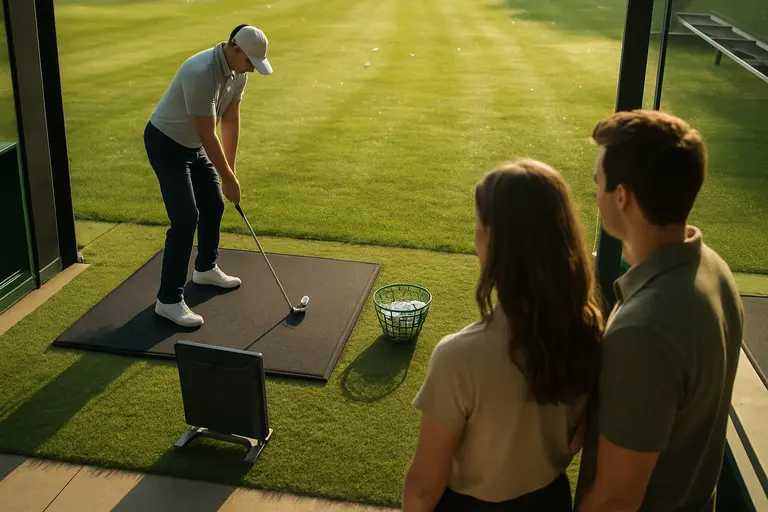
Warm Up, Then Hit Your Current Club First
Start with enough warm-up swings to find center contact. Cold swings can make a playable club look poor and a poor test club look fine by comparison. Once you are loose, hit your current club first. That is your control group. For driver, five to seven solid shots can show a pattern. For irons and wedges, you may need enough swings to spot carry gaps without tiring yourself out.
Bring the clubs you actually play, not just the club you think you want to replace. A driver fitting may reveal a fairway wood gap issue. An iron test may show that your hybrid and longest iron overlap. A wedge session may uncover that two clubs fly too close together on partial swings.
- Use the same ball type if the facility allows it.
- Label shots by club, loft setting, shaft, and ball.
- Delete obvious mishits only if the fitter agrees they do not reflect your pattern.
- Compare carry and dispersion before total distance.
- Stop testing when fatigue changes your swing.
Do Not Let One Number Run The Session
A BYO Launch Monitor gives you familiar data, but familiar data can still tempt you into number chasing. Driver ball speed is not the whole fitting. Iron carry is not the whole fitting. Wedge spin on a mat may not match spin from grass. The better question is whether the setup produces shots you would trust on the course.
If the fitter recommends a change, ask what problem it solves. Lower spin can help some driver fits, but too little spin can make ball flight unstable. More launch can help some players, but not if it creates a ballooning flight. Stronger iron lofts can add distance, but they can also change gapping. The right answer depends on your delivery, strike, and course needs.
For those exploring interconnected golf resources, AP Levante is part of a related network. At its core, the focus remains on practical club decisions: measure carefully, ask clear questions, and avoid paying for a change you cannot explain.
Bring-Your-Own Launch Monitor Days At Local Shops
The best local fitting events are structured, patient, and honest about what the data can and cannot prove. A BYO Launch Monitor day should help you see your current bag more clearly, test demo clubs against a fair baseline, and leave with notes you can use after the session. It should not make you feel rushed into a purchase because one shot looked good on a screen.
Go in with three priorities: know your baseline, test like-for-like when possible, and ask the fitter to connect each recommendation to a measurable pattern. If a new shaft tightens dispersion, ask where the data shows it. If a loft change improves gapping, write down the old and new carry numbers. If the results are mixed, it is fine to wait and retest on another day.
Bring-your-own days can be a smart bridge between solo practice and a full fitting appointment. They work because they combine your familiar data habits with an experienced fitter’s eye. Used that way, the monitor becomes what it should be: a tool for better club decisions, not a scoreboard for one perfect swing.