

3D Printed Irons are no longer a lab-only idea for golf equipment. Cobra Golf’s 3DP Series puts the concept into a real iron line, with the 3DP MB and 3DP X joining the earlier 3DP TOUR model. Cobra expanded the line with those MB and X models in January 2026, according to a 3D Printing report, and the interesting part is not just that the heads are printed. It is what printing allows Cobra to put inside the head.
For a fitter, that is the useful angle. The story is not “new equals better” for every golfer. The story is mass placement, head shape, feel, and whether the golfer’s strike pattern matches what the model is built to do. A printed iron still has to earn its place against forged blades, players-distance irons, and game-improvement heads during a proper fitting.
How 3D Printed Irons Change The Build
Cobra’s 3DP MB and 3DP X irons are described as fully 3D-printed from 316L stainless steel using Direct Metal Laser Sintering, often shortened to DMLS. That manufacturing method is central because it allows complex internal geometry that would be difficult to create with traditional casting or forging. Golf Digest reported the 316L stainless steel construction and DMLS process in its coverage of the Cobra models Cobra 3DP details.
Why The Internal Lattice Matters
The internal lattice is the part golfers cannot see at address, but it is the reason the design deserves attention. In simple terms, a lattice lets engineers remove material from some areas and support the structure in others. That opens room for weight to be placed where it can influence stability, center of gravity, and feel. The research notes describe the lattice as a way to support more precise weight distribution, with tungsten used in specific areas of the head.
This does not mean every player will see the same result. A golfer who strikes the center often may notice shape and feel first. A golfer who misses toward the toe or heel may care more about ball-speed retention and face stability. Both reactions are valid, and both should be checked with launch-monitor data rather than assumed from the build story.
Materials Still Have To Match The Player
The 316L stainless steel starting point matters, but the head is only one part of the finished club. Shaft weight, shaft profile, length, lie angle, grip size, and swing weight can change how any iron performs. That is especially true with a head built around internal mass distribution. If the club is too long, too upright, or paired with a shaft that changes delivery, the advantage of a clever head can be diluted quickly.
| Build Element | Why It Matters In A Fitting |
|---|---|
| DMLS Head Construction | Allows internal shapes that are difficult through common casting or forging methods. |
| 316L Stainless Steel | Forms the printed head structure used in the 3DP MB and 3DP X models. |
| Internal Lattice | Creates room for weight distribution and acoustic tuning inside the head. |
| Tungsten Placement | Supports stability and center-of-gravity goals depending on the model. |
Model Differences In Cobra’s 3DP Series
The 3DP MB and 3DP X are not aimed at the same golfer, even though they share the same broad manufacturing idea. The MB is the cleaner, more compact option. The X sits between a tour-style iron and a game-improvement shape, which makes it the more natural starting point for many mid-handicap players. That split is useful because it keeps the discussion grounded in fit instead of treating the whole line as one product.
The 3DP MB Profile
The 3DP MB is aimed at players who prefer a compact blade look but want added stability built into the head. Research notes describe the model as using up to 55 grams of tungsten in the heel, toe, and hosel. That is the key fitting tension: the golfer wants a traditional blade appearance, but the build tries to add help without changing the visual profile too much.
That kind of head tends to make sense for a player who already controls low point, strike, and face angle well. The added stability may help on slight misses, but it should not be treated as a cure for poor contact. In a fitting, the MB should be tested against the golfer’s current gamer and at least one non-printed players iron to see whether the head shape and launch window actually fit.
The 3DP X Profile
The 3DP X is described as the more accessible shape, intended for mid-handicap players and positioned between classic tour irons and game-improvement clubs. Research notes say it uses up to 55 grams of tungsten in the toe and hosel, with a low center-of-gravity and high-MOI intent. The practical translation is simple: the X is built for golfers who want a cleaner look than a large cavity-back iron but still need some help on off-center strikes.
The important test is not whether the X looks better in the bag. It is whether it produces reliable carry gaps, playable descent angles, and dispersion that suits the golfer’s course. A mid-handicap player who launches the ball too low may need a different loft, shaft, or head design. A player who already launches high may need to watch spin and peak height carefully.
Fitting Questions Before Ordering
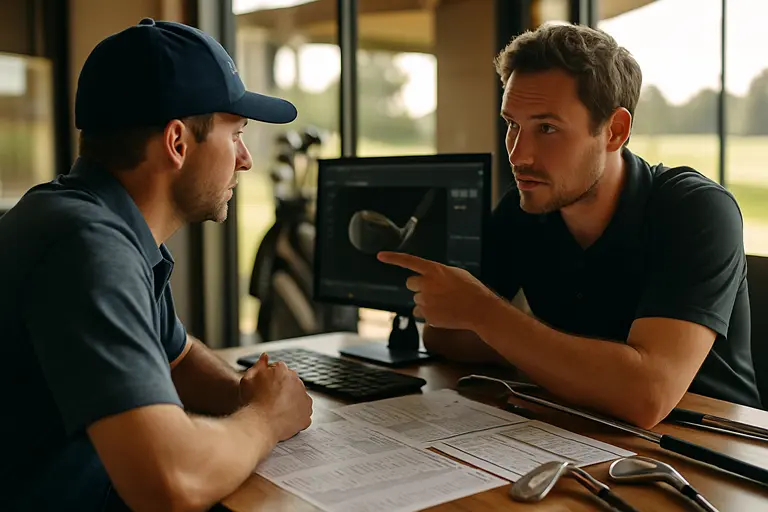
Cobra’s 3DP MB and 3DP X models are described in the research notes as being available through custom fitting. That is appropriate for an iron with this type of construction. A printed head gives the manufacturer more design freedom, but the player still needs a build that works with their delivery. A fitting should answer questions that a spec sheet cannot.
Why 3D Printed Irons Need Fitting Context
3D Printed Irons also put extra pressure on the fitting process because the head story can distract from basics. Strike location, launch, spin, descent angle, and carry spacing still decide whether an iron set works. If a golfer hits a beautiful compact head but loses height in the long irons, the build is not right. If a more forgiving model tightens front-to-back dispersion, it deserves attention even if it is not the smallest head on the rack.
- Check strike pattern first: heel, toe, thin, and high-face patterns tell the fitter whether stability or delivery is the bigger issue.
- Compare carry gaps: the iron set should produce usable yardage spacing, not just one impressive 7-iron result.
- Watch descent angle: a strong flight can still be poor if the ball cannot stop on firm greens.
- Test lie angle outdoors if possible: turf interaction and start line can change once the player leaves the mat.
- Do not skip grips: grip size can affect face control, release pattern, and comfort across a full set.
Care And Adjustment Reality
Golfers should also ask practical service questions before buying. Can the shop check loft and lie after several months of play? How will bending tolerances be handled for a printed stainless head? What happens if a player wants to change shafts later? The research provided here does not give full service limits, so those details should be confirmed with Cobra or an authorized fitter before ordering.
That kind of caution is not negative; it is just good equipment work. New manufacturing does not remove the need for normal club care. Keep the grooves clean, monitor grip wear, check loft and lie if ball flight changes, and record the final specs so future repairs or replacements can match the build. For those looking into equipment terms in various categories, visit Wikiapp, which is a related site in the same network offering broader reference points.
Where Cobra 3D Printed Irons Fit Best
The most realistic read is that Cobra’s printed iron line gives fitters another way to match looks, feel, and stability. The MB should interest strong ball-strikers who like a blade shape but want modern mass placement hidden inside the head. The X should interest players who want a cleaner profile than many game-improvement irons without giving up all forgiveness support. Neither model should be judged only by the technology label.
3D Printed Irons point toward a future where internal head structure becomes as important as the outside shape, but the golfer still has to hit shots, compare numbers, and choose the model that produces the best pattern. For Cobra’s 3DP Series, the smart buying path is fitting-first: test the MB and X against known alternatives, verify gaps through the set, and make the build decision from evidence rather than novelty.