

driver forgiveness is one of the most misunderstood ideas in a driver fitting. Many golfers walk into a bay assuming the biggest head, the stiffest-looking shaft label, or the lowest-lofted head will protect them from mishits and add easy distance. Callaway fitting insight, as reported through comments from Senior Custom Fitter Luke Verney, points in a more useful direction: forgiveness has to match the golfer’s delivery, strike pattern, face control, and ball flight.
That matters because a driver does not become a good fit just because it has a friendly marketing category. A head can be stable and still aim the ball pattern in the wrong direction. A shaft can have the label a golfer expects and still deliver the head poorly. A loft setting can look powerful on the sole and still create weak launch, inconsistent contact, or compensations that follow the player onto the course.
Driver Forgiveness Starts With Fit, Not Size
The common shortcut is simple: bigger head equals safer driver. That can be true for some players, but it is not a rule. Verney told Golf Monthly that a larger head with high MOI, such as the Callaway Quantum Max D referenced in the report, may still be wrong for a golfer if its draw bias does not fit the player’s pattern, according to this Golf Monthly interview. The takeaway is not that larger heads are bad. It is that size alone cannot choose the club.
Driver Forgiveness And Head Size
The fitting answer is that driver forgiveness is not a single feature. It is the result of the head, loft, shaft, length, face angle, weighting, and the golfer’s strike working together. If a player tends to miss high on the toe, the head that protects speed and direction on that miss may not be the same head that helps a player who strikes low on the heel. Both players may ask for “maximum forgiveness,” but the build that helps one could hurt the other.
This is why a fitter should watch impact before making a head recommendation. A stable head can reduce punishment on certain mishits, but it cannot erase a face-control problem or a pattern that starts too far left or right. For a deeper related discussion, our note on why driver head size is only part of fitting explains why loft, center of gravity, shaft length, and strike pattern need to be tested together.
Draw Bias Is Still A Fit Question
Draw-biased heads can be useful for golfers whose delivery leaves the face open or whose pattern leaks right. But that same bias can be a poor match for a player who already starts the ball left, turns the face over quickly, or fights a hook. A larger draw-biased head may be described as forgiving, yet the on-course result can still be uncomfortable if it shifts dispersion into the wrong miss.
That is the fitting-first point: a golfer should not shop only by category name. “Max,” “D,” “LS,” and similar labels are starting points, not verdicts. The right test is whether the driver produces a playable pattern on repeated swings, not whether the head looks safe at address or sits in a high-forgiveness product family.
What Callaway’s Insight Means In The Bay
Callaway’s fitting message, based on the research notes, is useful because it moves the golfer away from assumptions and toward observation. In a fitting bay, the fitter can compare heads while watching how the golfer delivers the club. That is different from asking a player’s handicap, hearing a swing-speed number, and pulling one expected model from the wall.
Swing Speed Is Only A Starting Point
Swing speed matters, but it is not enough. EP Golf Studios makes the same point in its discussion of driver fitting myths: two golfers with the same swing speed may need different driver specifications because delivery, strike location, and face control can vary, as explained in its EP Golf Studios fitting myths. That is a key reason launch-monitor data should sit beside the fitter’s eye, not replace it and not be ignored.
Think of two players who both swing within the same speed band. One may deliver the club with too little loft and strike low on the face. The other may add loft and strike high on the face. Giving both golfers the same head and shaft because the speed number matches is a rough guess, not a fitting decision.
Handicap Does Not Pick The Head
Handicap is another weak shortcut. A low-handicap golfer may still benefit from a high-stability head if the miss pattern calls for it. A higher-handicap golfer may hit a more compact or differently biased head better if it lines up with delivery and strike. The scorecard tells you something about the player’s scoring level, but it does not show impact location, face angle tendencies, or comfort at address.
This is where fitting should stay practical. The fitter is not trying to reward a good player with a “player” head or assign a beginner the largest model by default. The goal is to identify which head gives the player a repeatable start line, playable curve, and acceptable strike pattern for the way that golfer actually swings.
Loft, Strike, And Driver Forgiveness
Loft is another area where golfers often chase the wrong idea. The research notes say Verney identifies too little loft as a common equipment mistake, with golfers often believing less loft will create more distance. In a fitting bay, too little loft can push a player toward technical compensations and inconsistent strikes, especially if the player starts trying to help the ball into the air.
Too little loft can make driver forgiveness harder to access because impact and launch start working against the golfer. If the head is not launching the ball in a usable window for that player, the golfer may change posture, release, or tee height to force the flight. That can move strike around the face, which reduces the value of any stable head design.
The better process is to test loft as part of the whole build. Loft should be judged by the ball flight it produces, the strike it encourages, and the player’s ability to repeat it. Our related piece on correct loft selection covers why choosing loft from ego or a distance myth can create more problems than it solves.
On the course, this shows up quickly. A driver that looks long during one perfect strike but produces weak launches, heavy curvature, or poor contact under pressure may not be the best club for scoring. A slightly different loft, head bias, or shaft pairing may give the player a tighter pattern, even if it does not win a one-swing contest in the hitting bay.
Shaft Labels And Aftermarket Assumptions
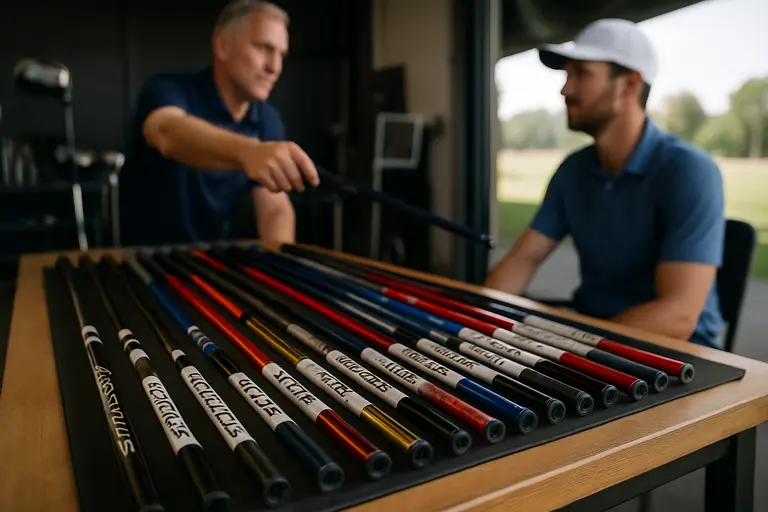
Shaft flex labels create another common fitting trap. The research notes from EP Golf Studios state that terms such as regular, stiff, and X-stiff vary between brands and lack standardization. That means a golfer should be careful about treating the label as a reliable measurement. A “stiff” shaft from one line may not feel, load, or deliver the same as a “stiff” shaft from another line.
Flex Is Not A Universal Language
In practice, the fitter needs to test how the shaft works with the golfer’s tempo, transition, release, and strike pattern. The goal is not to put a player into the most impressive label. The goal is to help the player deliver the head in a way that supports the intended flight. Without launch-monitor data and real shots, the label alone does not tell the full story.
Aftermarket shafts deserve the same sober treatment. They can be a good fit for some golfers and unnecessary for others. The value depends on the player’s swing characteristics and the test results, not the price tier or the assumption that an upgraded shaft must be better. A fitting should compare outcomes, not status.
To keep track of sports and reference material, resources such as WikiApp are invaluable for organizing knowledge, yet the most important factor remains testing the club in hand and observing the results.
Booking A Driver Fitting Around Driver Forgiveness
The best driver forgiveness choice is the one that protects your real miss without creating a new one. Before booking, a golfer should think less about asking for a specific head and more about bringing clear information: current driver model, typical miss, preferred shot shape, and any ball-flight problem that keeps showing up on the course.
- Bring your current driver so the fitter has a baseline rather than a guess.
- Describe your most common on-course miss, not only your best range shot.
- Test more than one loft or setting if the fitter sees launch or strike issues.
- Treat shaft flex labels as trial categories, not final answers.
- Judge the club by repeated pattern, comfort, and ball flight rather than one peak swing.
A good booking is not about being sold the biggest head or the newest shaft. It is about narrowing choices with evidence. Some players will leave with a larger, more stable model. Some will fit better into a different shape, loft, or bias. Some will find that their current head is close, but the setting, shaft, or loft needs attention. None of those results should be assumed before the fitting starts.
That is the practical lesson from Callaway’s fitting insight and the wider fitting discussion: forgiveness is personal. The driver that helps one golfer keep the ball in play may overcorrect another golfer. The fitting bay gives you a controlled place to test those differences before taking the club to the first tee.