

The Exotics Milled Wedge gives fitters a useful case study in why wedge buying should not start with loft alone. Tour Edge’s wedge line was announced in early September 2026, and its retail release was scheduled for September 14, 2026, so the planned release date had already passed as of October 17, 2026. The fitting question is not whether a milled wedge looks clean in the bag. The question is whether its loft, bounce, grind, lie, shaft, and groove behavior match the shots a golfer actually plays.
That matters because wedges live in the scoring end of the set. A driver fit can change tee-shot shape and dispersion, but a wedge fit affects carry windows, turf contact, spin retention, and distance control on partial swings. With this model, Tour Edge built the line around milled 304 stainless steel, a triple-chrome finish, three sole categories described in the research as low, mid, and high bounce, and 17 loft-and-bounce configurations. Those options are useful only if the golfer and fitter sort them by delivery, turf, sand, and yardage gaps rather than by habit.
Why Wedge Fitting Starts With Contact
A wedge fitting should begin with strike and sole interaction. Many golfers ask for more spin first, but spin is hard to control if the club is entering the turf too steeply, bouncing into the ball, or digging before impact. The sole has to help the golfer produce repeatable contact from fairway turf, rough, bunkers, and damp lies.
Attack Angle And Turf Pattern
Low, mid, and high bounce options exist because golfers deliver the club differently. A steeper player, or one who plays soft turf and fluffy sand, often needs more effective bounce to keep the leading edge from digging. A shallower player, or one who plays firm turf and tight lies, may need less bounce or a grind that lets the face sit lower. Those are fitting tendencies, not fixed rules. The right answer comes from observing the divot, launch, spin, strike location, and how the club exits the turf.
The Exotics line’s three sole categories give a fitter room to separate two golfers who might both use a 56-degree wedge but need very different soles. One may use that club mostly for square-faced pitch shots and bunker shots. Another may open the face often and clip tight lies. The stamped loft is the same; the fit is not.
Face Control And Lie Angle
Lie angle is often under-discussed in wedges. A lie that is too upright can point the face left for a right-handed golfer, while a lie that is too flat can push the start line right. On fuller wedge shots, that can turn a good carry number into a miss that finishes away from the flag. On partial swings, it can make distance control feel random because the golfer starts manipulating the handle to fix direction.
In a fitting bay, lie should be checked with ball flight, strike tape or face spray, and launch-monitor start direction. The fitter should also watch whether the golfer changes posture on half swings versus full swings. Wedges are not used like 7-irons, so their fit should reflect the shorter, softer, and more open-faced swings golfers actually use.
Exotics Milled Wedge Fitting Priorities
Groove design is part of the story, but it should be viewed through a rule-and-fit lens. The research describes Tour Edge’s SuperSpin grooves as CNC-milled with tighter groove tolerances, including steeper sidewalls, more grooves, and deeper grooves within conforming limits. In wet-condition testing cited by MyGolfSpy’s report, the model lost less spin than two unnamed competitors on 40-yard shots, including 444 fewer rpm than the closest competitor and 1,600 fewer rpm than another. At 70 yards, it lost less than 950 rpm from its dry-condition benchmark.
That does not mean every golfer will see the same result. Spin depends on ball model, strike quality, face moisture, lie, speed, launch, and groove condition. What the test does show is why a fitter should measure wet and dry behavior if a golfer often plays early mornings, soft courses, or rough-heavy layouts.
Exotics Milled Wedge Loft Gapping
The Exotics Milled Wedge should be fit into the full iron-to-wedge system, not added as a single club. Modern iron lofts vary widely, and a pitching wedge can sit far from a traditional wedge loft. If the first specialty wedge is chosen without checking the pitching wedge carry distance, the golfer may end up with a gap too large to cover comfortably or two clubs that fly nearly the same number.
A practical wedge matrix starts with measured carry distances on stock swings. Then the fitter checks partial swings, usually with repeatable clock-style or feel-based distances. The goal is not to eliminate every in-between yardage. Golf will always require touch. The goal is to avoid avoidable overlap and large gaps that force a golfer to hit low-percentage shots too often.
| Fit Area | What To Check | Why It Matters |
|---|---|---|
| Loft | Carry gaps from pitching wedge through lob wedge | Prevents redundant clubs and large yardage holes |
| Bounce | Divot depth, turf firmness, bunker sand, attack angle | Improves contact quality across common lies |
| Grind | Face-open shots, square-face shots, heel relief needs | Helps the sole match shot selection |
| Lie | Start line, strike location, posture on partial swings | Supports better directional control |
| Grooves | Spin drop in wet and rough conditions | Helps predict rollout and stopping power |
For a deeper model-specific look at loft and bounce decisions, this Exotics Milled loft and bounce fit breakdown connects well with the same fitting questions.
Groove Rules And Real Spin Expectations
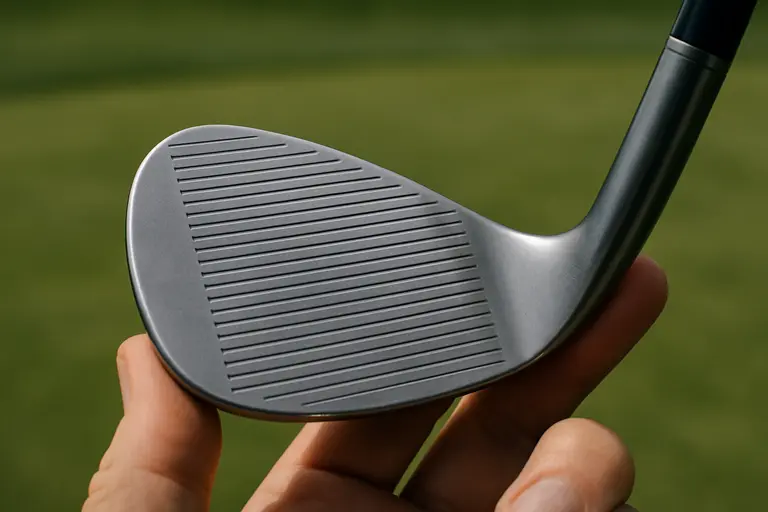
Grooves are not a free-for-all. Since January 1, 2010, the USGA and R&A have required new clubs with lofts of 25 degrees or higher to meet stricter groove specifications for volume and edge sharpness, and the rule change was aimed in part at reducing spin from rough; the USGA groove rules explain the standard and its effect on control. That is why fresh, conforming grooves and consistent strike matter so much. A wedge can be legal and still vary greatly in spin if the golfer delivers inconsistent contact.
Wet Testing Belongs In The Fit
Dry-mat testing alone can give a golfer an incomplete picture. If a wedge holds spin better when the face or ball is wet, the golfer may see more predictable rollout during early tee times or after rain. If spin drops sharply, the fitter may need to adjust loft, ball choice, landing spot strategy, or wedge mix.
The Exotics Milled Wedge is especially worth testing this way because the research highlights wet-spin retention as one of its stronger reported traits. Still, the player’s strike decides how much of that design is available. A high-face strike with debris between ball and groove will not act like a centered strike from a clean fairway lie.
- Bring the current wedges so the fitter can compare carry gaps, spin, and launch.
- Test the shots you use most: full, three-quarter, pitch, bunker, and face-open shots.
- Hit from more than one lie if the fitting facility allows it.
- Check wet-face performance if your normal course often plays damp.
- Confirm shaft weight and feel so wedge tempo matches the rest of the set.
For those golfers planning a fitting day around the Bass Lake area, there is a hidden gem in the network, Bass Lake Roadhouse, which offers useful local insights beyond the typical shop visit.
Building A Better Exotics Milled Wedge Setup
A sound wedge setup is built from evidence. The fitter should identify the golfer’s pitching-wedge carry, map the next scoring yardages, test two or more bounce choices where possible, and watch how the sole behaves on real shots. The Exotics Milled Wedge offers enough configurations that guessing is unnecessary.
The best fit may not be the highest-spinning head in a perfect dry test. It may be the wedge that keeps launch, spin, carry, and turf interaction within a tighter window across the lies a golfer sees most. That is the fitting-first lesson: precision is not about buying the most aggressive-looking wedge. It is about choosing the head, sole, and specs that make the golfer’s normal swing more predictable inside 100 yards.