

The Golf VX Simulator has been tested publicly enough now that fitters and serious golfers can start asking better questions. Not hype questions. Shop questions. Does the moving lie matter? Is the feedback fast enough to trust? Which numbers help with a club decision, and which numbers are better used for practice context?
That distinction matters in a fitting bay. A simulator can make indoor golf feel more like outdoor golf, but a club purchase still needs a clear process: strike, launch, spin, descent, face delivery, start line, and dispersion. The recent Golf VX Quantum testing gives us useful talking points, especially for players who want indoor practice to feel less flat and more course-aware.
What The Golf VX Simulator Tests Showed
Moving Lies Changed The Indoor Test
On September 15, 2026, Tom’s Guide tested Golf VX’s Quantum system in Arlington Heights, Illinois, and reported a 15-axis swing plate that can move the hitting surface for uphill, downhill, and sidehill lies, along with a ceiling-mounted Q-Mat projector that shows swing and shot data on the floor near the player Tom’s Guide testing. That is a big change from the usual indoor bay, where every shot is hit from a perfectly level mat.
From a fitting standpoint, the moving floor is the headline, but it is not the whole story. A golfer can hit a 7-iron beautifully from a level mat and still struggle when the ball is above the feet. The club has not changed, but posture, balance, swing direction, low point, and face control can all change. A simulator that can introduce lie angle challenges gives a fitter another way to see how a player adapts.
That does not mean every iron fitting should be run on a moving plate. Most fittings still need a stable baseline first. The player has to show normal strike tendencies before the lie is changed. Once the baseline is clear, a fitter can use an uneven stance to test whether the recommended shaft, head, length, and lie angle still make sense when the swing gets less comfortable.
Golf VX Simulator Data A Fitter Can Use
MyGolfSpy published its independent testing on September 25, 2026, reporting that the Quantum system captured more than 28 data points per shot, used 4,000-fps sensors for ball and club tracking, included a 436-fps swing camera, and showed about 15 milliseconds of response time from swing to screen MyGolfSpy test notes. Those details are the kind of things a fitter cares about because they affect trust in the session.
Fast visual response helps the player connect feel to flight. If the picture arrives late, some golfers start guessing. If the feedback appears almost immediately after impact, the player can compare the shot to the swing they just made. That is useful during a lesson, a gap check, or a fitting where the golfer is testing two shafts that feel close.
The other useful piece is data depth. More data is not automatically better. It is better only when the fitter can sort signal from noise. Ball speed, launch angle, spin rate, carry, descent angle, club path, face relationship, and strike pattern all have practical value. A long list of numbers can still lead to a poor recommendation if the player never gets a clean explanation of what changed and why.
Why This Matters For Local Fittings
Floor Data Is Not The Same As Ball Flight
That is where a Golf VX Simulator session needs a fitter’s eye. The screen can show a shot. The data can explain parts of it. The player still needs someone to connect the measurement to the club. A toe strike with low spin is not fixed the same way as a centered strike with too little launch. A pull from a sidehill lie is not the same problem as a pull from a level mat.
Good indoor fitting starts by separating equipment issues from delivery issues. If a player’s strike location improves with a shorter shaft, that is useful. If the player only hit one good shot because the screen looked exciting, that is not enough. The goal is not to chase the biggest single number. The goal is to build a setup that produces repeatable windows for the player’s real swing.
Uneven lies can help expose that reality. Some golfers lose posture. Some get steep. Some shut the face. Some back away from the shot and lose speed. A moving platform can show those habits faster than a flat mat, but the fitter still has to decide how much of that belongs in the club recommendation. A club should not be built only around one awkward lie unless that lie matches the player’s normal course problem.
Better Practice Starts With Better Questions
For local shops, the best use may be blending fitting and practice. A player can get a baseline fitting, then use the same style of simulator data to train the pattern that came out of the session. That is a cleaner loop than buying clubs, guessing at the range, and coming back months later unsure what changed.
Golfers should ask simple questions before any indoor session:
- Which ball and club data will be shown during the session?
- Will strike location be measured or checked during testing?
- Will the fitter compare level lies and uneven lies separately?
- How will the final recommendation be explained after the session?
- Will the golfer receive useful notes, not just a screen full of numbers?
Those questions keep the session practical. Simulator golf can feel impressive, but an in-shop fitting should still end with plain-language reasons for any club change. If the recommendation is a shaft, the fitter should explain what it did to launch, timing, strike, or dispersion. If the recommendation is no change, that should be said clearly too.
For readers comparing this system through a fitting lens, our related Golf VX Quantum fitting view covers how moving lies and launch data can fit into indoor club services without treating the simulator as a shortcut.
Pricing And Room Questions Before You Book
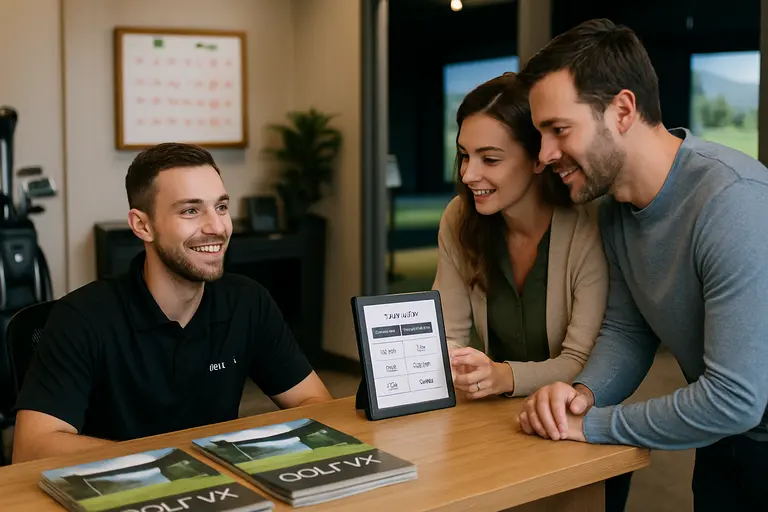
What Is Included In A Bay Session
The public tests tell us quite a bit about the Golf VX Quantum technology, but they do not answer every pricing question a golfer should ask before booking time. That is normal. Bay time, instruction, fitting, club build work, and simulator play are often priced differently. A one-hour practice rental is not the same service as a driver fitting or an iron gapping session.
A golfer should ask what is included before paying. Is the session self-guided, coached, or fitted? Is club comparison part of the price? Are shaft and head options available during the appointment? Will the player get a printout or digital notes? Is ball type controlled? Are shoes, tees, and warm-up time included? None of those questions are flashy, but they prevent confusion at the counter.
Shops should be just as clear. If a session is practice only, say that. If it includes a fitter, say how the time will be used. If build work is separate, say so before the golfer starts testing. Pricing transparency is not about being the cheapest. It is about making sure the golfer understands the service before the first swing.
What Shops Still Need To Explain
The Golf VX Simulator is not magic, and that is a good thing to say out loud. The more realistic the bay becomes, the more tempting it is to treat every simulated result as a course result. Indoor golf still has limits. Turf interaction is different from grass. Wind, temperature, pressure, rough, wet lies, and uneven outdoor footing can change the shot. A fitter should respect the simulator data without pretending it replaces the course.
That balanced view helps beginners too. A new golfer may not need every data point explained in full detail. They may need contact, start line, basic distance gaps, and a club setup that does not fight them. A better player may want more detail on face-to-path, dynamic loft, spin loft, and landing angle. The same simulator can serve both golfers, but the explanation should match the player.
For local sports readers who like gear talk in more than one sport, our same network includes Books on Baseball, which covers baseball reading with the same practical sports-first approach.
Golf VX Simulator Fit Questions To Ask In Shop
Use The Tech, But Keep The Club Decision Grounded
The best takeaway from the recent testing is simple: if Golf VX Simulator sessions are available near you, treat them as a strong tool, not a promise. Moving lies can make practice more realistic. Fast feedback can help a golfer connect swing and shot. A deeper data set can give a fitter more evidence. None of that guarantees lower scores or longer drives by itself.
For a fitting, the strongest use is comparison. Hit the gamer club. Hit the test build. Change one variable at a time when possible. Watch strike, launch, spin, carry, peak height, descent, and dispersion. Then test whether the better result repeats. If the simulator adds uphill, downhill, or sidehill lies, use those shots as a stress test after the level-mat baseline is already understood.
For a practice session, set one job for the appointment. Work on wedge distance control, driver start line, iron gapping, or uneven-lie balance. Do not turn every session into a full bag overhaul. The value of a high-end simulator is not just that it shows more information. The value comes when the golfer and fitter decide which information matters for that day.
The recent Golf VX Quantum testing showed a system with unusual indoor realism, fast feedback, and a large measurement set. For local golfers, that is worth paying attention to. Just keep the fitting process grounded: measure the shot, explain the miss, test the option, and make the club decision only after the pattern is clear.