

Forget the marketing haze. You’re not just shopping for a magic box that spits out numbers.
You’re choosing a philosophical lens for your golf swing. Is your game a story best told by the whispering Doppler radar of a TrackMan, the forensic, frame-by-frame autopsy of a GCQuad’s cameras, or the neuroscientific breakdown of a SAM PuttLab on the green?
I’ve stood in front of the orange behemoths and the sleek photometric units. The first question isn’t about price. It’s about perspective.
This section unpacks the core DNA of each system. We’ll explore what they physically measure and what that measurement truly means.
TrackMan 4 uses dual radar sensors to track the entire ball flight like an NSA satellite. The Foresight GCQuad employs four quadrascopic cameras, capturing impact with the intimate detail of a Kubrick film shot.
Then there’s the specialist: the SAM PuttLab, dedicated solely to the art of the green. Other models, like the Full Swing KIT, blend a 4K camera with Doppler radar for a hybrid approach.
This is the foundational “what” before we get to the “so what.” Understanding these launch monitors is the first step to a fit that actually fits you.
What Each System Measures
Think of your golf swing as a story. TrackMan writes the epic tale of the ball’s flight. GCQuad drafts the detailed report on the club’s impact. SAM PuttLab keeps a personal diary of your putting stroke. They all tell the same story but in different ways. You need to choose which story you want to hear most.
TrackMan is the favorite of many pros. It uses dual radar technology to track the ball from start to finish. It gives you all the details like spin rate, launch angle, and carry distance.
But TrackMan also shows you the small stuff. It tells you about spin axis, descent angle, and total distance. This is why club fitters and pros love it for fine-tuning their game.
The GCQuad is all about the impact. It uses four ultra-HD cameras to capture what happens right before the ball flies. It’s all about the club data, like club path and angle of attack.
Its special trick is measuring impact location on the clubface. This shows you why you’re missing the mark. A high, toe-side strike? That’s your slice explained.
SAM PuttLab focuses on your putting stroke. It uses ultrasonic sensors to measure your stroke in great detail. It looks at tempo, rotation, and face alignment at impact.
It analyzes your putter’s loft and lie too. It breaks down your stroke into geometric and kinematic parts. This helps you figure out if you’re pushing, pulling, or just off rhythm.
There are other systems out there too. The Full Swing KIT tracks up to 16 data points, combining camera and radar. The Rapsodo MLM2PRO offers solid ball data like speed and launch angle. But the main question is: do you want to analyze the ball’s journey or the club’s interaction?

This table is more than just specs. It’s your guide for choosing the right system for your needs.
| System | Primary Focus | Key Metrics Measured |
|---|---|---|
| TrackMan 4 | Ball Data | Spin rate, launch angle, height, carry distance, spin axis, descent angle, total distance. |
| GCQuad | Club Data & Ball Data | Club path, lie angle, angle of attack, face angle, dynamic loft, impact location. |
| SAM PuttLab | Putting Analysis | Stroke tempo, face rotation, alignment at impact, putter loft/lie, path. |
| Full Swing KIT | Hybrid Data | Comprehensive set of 16 ball and club data points. |
| Rapsodo MLM2PRO | Essential Ball Data | Ball speed, launch angle, carry distance, shot shape visualization. |
So, which system is the best? It depends on what you need. TrackMan is great for ball flight and launch conditions. The GCQuad is perfect for fixing your swing mechanics at impact.
Indoor vs. Outdoor Accuracy
The debate in golf tech is not just about what you like. It’s about physics and what works best. Can you trust the numbers when hitting into a net versus outdoors? It all depends on your monitor’s type.
Radar systems like TrackMan and FlightScope Mevo+ are for the outdoors. They need a clear view of the ball’s flight to work well. Think of them as long-lens cameras. They’re great outside but struggle indoors.
Using a TrackMan indoors is like driving a Ferrari in city traffic. The power is there, but it’s not fully used.
Camera-based units like the GCQuad and Uneekor Eye Mini Lite are for indoors. They use high-speed cameras to capture impact details. They don’t need space behind the ball. But, direct sunlight outdoors can mess with their sensors.
According to industry-leading equipment reviews from Golf Digest, the shift toward “portable” pro-grade tech has made the choice between indoor and outdoor accuracy more competitive than ever. Your main practice area should guide your choice. If you’re building a swing in your basement, you need a system that thrives there. If you’re chasing tour-level precision on grass, you need the outdoor specialist.
| System Type | Ideal Environment | Key Compromise | Best For |
|---|---|---|---|
| Radar (TrackMan, Mevo+) | Outdoor Range | Struggles with limited indoor space | The player who practices mostly outside |
| Camera (GCQuad, Eye Mini) | Indoor Simulator | Can be challenged by bright outdoor light | The garage golfer or studio fitter |
| Hybrid (Rapsodo MLM2PRO) | Both Indoors & Out | May not lead in either specialty | The player who needs flexibility |
This isn’t just about convenience. It’s about getting accurate feedback. If you’re building a swing in your basement, you need a system that thrives there. If you’re chasing tour-level precision on grass, you need the outdoor specialist. Understanding this core distinction is central to our fitting philosophy, where matching the tool to the environment is the first step.
Choose wrong, and you’re optimizing your swing for a reality that doesn’t exist. Choose right, and you get a trusted coach, rain or shine. When you’re investing in improvement, the integrity of your club data is non-negotiable.
Speed/Spin/Face Delivery Insights
Understanding launch monitor data is more than just numbers. It’s about uncovering the story behind your misses. Speed, spin, and face delivery are key to solving issues like a slice or fade.
Speed is not just one number. You have club speed, ball speed, and smash factor. A monitor like the PRGR gives you these stats. But it’s the action you take that matters.
A high-quality launch monitor shows how these numbers relate. If your ball speed is low compared to club speed, it’s a face contact issue. Fixing this can add yards to your game.
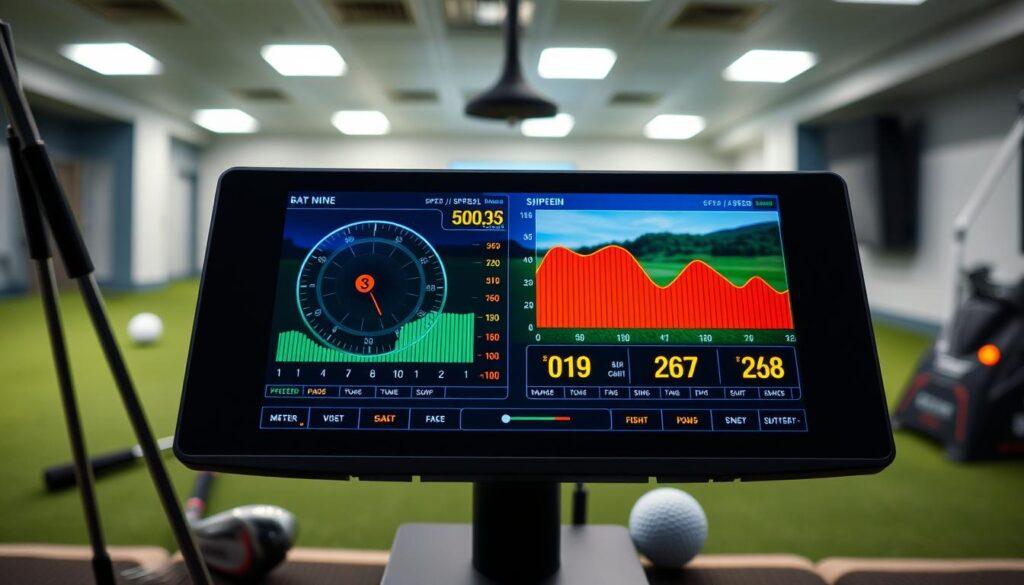
Spin adds complexity. Too much backspin in your driver can make the ball fly too high and lose distance. Too much side spin causes slices or hooks. Radar systems like TrackMan measure spin in flight, giving real-world data. Camera systems calculate it from the ball’s image at impact.
Which is more accurate? For most, the key insight is reducing side spin by squaring the face. A good launch monitor shows the spin axis and links it to your face angle at impact.
Face delivery is the moment of truth. High-speed camera systems, like the GCQuad or Full Swing KIT, capture impact. You see if the face is open, closed, or square. This gives you proof, not just guesses.
This is vital for fixing path issues. Seeing your club’s path and face angle at impact explains your slice better than any theory. The Full Swing KIT’s slow-motion review makes this analysis real. For putting, systems like GCQuad’s “Essential Putting Analysis” and TrackMan’s tools analyze face angle at impact on the green, too.
| Critical Insight | Radar-Based Systems (e.g., TrackMan) | Camera-Based Systems (e.g., GCQuad, Full Swing KIT) | Budget Monitors (e.g., PRGR) |
|---|---|---|---|
| Speed Insights | Comprehensive ball flight data; emphasizes speed’s role in total distance. | Direct measurement from impact; clear smash factor feedback for centeredness. | Basic swing and ball speed; good for gauging raw power. |
| Spin Insights | Direct spin measurement in flight; excellent for analyzing shot shape and apex. | Spin calculated from impact visuals; highly accurate for backspin/sidespin cause. | Often lacks detailed spin data; not reliable for shot-shaping diagnosis. |
| Face Delivery Insights | Inferred from ball flight math; good for experienced players who trust the model. | Visual proof of face and path at impact; eliminates doubt for fixing hooks/slices. | Minimal to no face delivery data; cannot diagnose path or face issues. |
Which insight is most important to you? If you’re fighting a two-way miss, face delivery data is key. For optimizing driver carry, spin data is essential. And for knowing if you’re getting faster, a simple monitor works.
The goal is to turn your wedge game into a strength. Knowing your exact spin rates from 50 yards helps with distance control. It turns guesswork into precision. This is the real power of these insights—they change your strategy, not just your swing.
In the end, the best launch monitor for you is the one that gives you the actionable insight you need. The data is only as good as the change it inspires.
Data Transparency & Take‑Home Reports
In today’s world, your golf swing data might be held hostage. You pay for the fitting and clubs. But do you own the ball data that justified the purchase? Often, the answer is a frustrating, “It depends.”
The take-home report is more than a keepsake. It should be your guide. With systems like GCQuad, you get detailed reports. But is it the raw data or a polished version? Trackman’s system offers deep insights, but it might feel restrictive.
Here’s a twist. Many top systems require a yearly fee to access your data. Your fitting data isn’t just stored on a hard drive. It’s in the cloud. Foresight and Trackman use cloud storage, but forget your login and your data might as well be lost.
But there are simpler, more modern options. The Full Swing KIT app is top-notch for user experience and data display. Rapsodo’s MLM2PRO offers cloud storage for 10,000 shots. And the PRGR device is simple, storing your shots without any monthly fees.
| System | Report Format & Transparency | Data Access Model | The Catch or The Charm |
|---|---|---|---|
| Foresight GCQuad | Detailed PDF fitting report. Detailed but may not include raw data sets. | Cloud storage via software. Often tied to ongoing facility or individual subscriptions. | Professional-grade depth, but access is typically subscription-based. |
| Trackman | Extensive, visually rich reports within its ecosystem. Highly transparent on presented metrics. | Full historical access requires an active TM subscription plan. | A walled garden. Beautiful and insightful, but you need a key to stay inside. |
| Full Swing KIT | App-centric. Real-time data and session history in a user-friendly interface. | Data lives in the app/cloud. No mandatory annual fee for basic access post-purchase. | Praised for its app. A more consumer-friendly model for data ownership. |
| Rapsodo MLM2PRO | App-based video and data overlay. Good transparency on key launch monitor ball data. | Cloud storage for 10,000 shots included. Subscription unlocks advanced features, not core access. | Generous storage baseline. Your data isn’t held hostage for a yearly ransom. |
| PRGR | Simple numerical display. Minimal “report” but all data is present in the moment. | No cloud. Data is session-based or stored minimally on the device. | You own nothing in the digital sense, but you’re also free from any platform. |
So, what’s the key takeaway? Before your fitting, ask about your data’s format and access. Treat your report as a guide, not just a receipt. Ensure you can access your data later. If not, you didn’t buy data. You rented a memory.
Booking the Right Bay
Knowing the tech is academic if you book time with the wrong tool. This is your playbook.
Are you chasing driver distance? A bay with TrackMan or FlightScope is your lab for optimizing launch and spin. Obsessed with iron precision? A GCQuad bay is your temple of consistency. Fighting the yips? Insist on a facility with a SAM PuttLab. The equipment listed on a venue’s website is a dead giveaway of its fitting philosophy.
Your first question when calling isn’t just “What launch monitor do you use?” The follow-up is the power move: “How will you use its club data to fix my specific problem?” This turns specs into strategy.
Simulator bay rates in the US often mirror the UK range, starting around $40 per hour off-peak and climbing past $60 for prime time. Many venues offer memberships, packages, and lessons with PGA professionals. Corporate events are a staple. Your goal dictates your investment.
Booking the right session transforms raw numbers into a personal blueprint. The right bay delivers actionable club data, not just a screen. It’s where your knowledge meets their tech, and your game gets the upgrade it deserves.