

Scheduling a premium clubfitting isn’t just about buying something new. It’s about getting better data for your game. Think of your golf game as a political campaign. Your swing is the platform, and your clubs might need an update.
The fitting bay is where facts win, not feelings. Experts like Club Champion’s PA studios aim to find the best club combination. They want to lower your scores by engineering a consistent strike.
This approach makes scoring under 100, 90, or 80 a real goal. So, how do you book fitting that cuts through the marketing? See it as the first step in a smarter game plan.
In Southeastern PA, connect with local experts who know your turf and weather. A studio like FS Golf offers a data-driven approach. They fit you, not just sell you. Ready to elevate your game? Let’s get started.
Choosing Your Fitting Type (Driver, Iron, Wedge, Putter, Full Bag)
Deciding what to focus on first is key in your golf fitting journey. Walking into a fitting without a clear goal is like asking a mechanic to fix your car without telling them what’s wrong. It’s not very effective.
Your golf bag is like a collection of special tools, each designed for a specific task. Picking the right one to work on can make a big difference. It’s like choosing the right tool for the job, not just any tool.
Let’s look at the different tools in your bag. Experts say you should update your full bag every 2-3 years. Some clubs, like wedges, might need more frequent checks. Here’s what each fitting type offers.
| Club Type | Primary Mission | Typical ROI | Recommended Frequency |
|---|---|---|---|
| Driver | Maximum Distance & Launch | Raw power off the tee; engine tuning. | As needed, or with major tech shifts. |
| Irons | Consistent Accuracy & Gapping | Tighter dispersion; suspension tightening. | Every few years, or if swing changes. |
| Wedges | Precision Scoring & Spin | Up-and-down percentage; special ops precision. | Annually or bi-annually (wear is high). |
| Putter | Holing Putts & Speed Control | Fewer three-putts; the diplomat’s touch. | When confidence wanes, or for new tech. |
| Full Bag | Complete System Harmony | Overall handicap reduction; D-Day for your game. | The 2-3 year strategic overhaul. |
A driver fitting is for those who want to hit the ball far. It’s about making your driver more powerful. If your drives aren’t impressive, this is your chance to improve.
The iron fitting focuses on accuracy and distance. It’s about making every iron shot consistent. If you’re missing greens, it’s time to fine-tune your irons.
Wedge fittings are all about precision near the green. Wedges wear out quickly, so they need regular check-ups. A good wedge fitting can make a big difference in your short game.
The putter fitting is all about making putts. It’s about finding the right putter for your stroke. A well-fitted putter can turn uncertain putts into confident ones.
A full bag fitting is like a complete overhaul of your game. It ensures every club works well together. This is the best way to improve your overall game.
Remember, a good fitter can work with what you have or suggest new clubs. The goal is to make your game better, no matter what.
So, think about where your game is losing strokes. Choose the right fitting type to fix it. It’s how you turn a good plan into a winning strategy.
Online vs. Phone Booking: Step-by-Step Walkthrough
Choosing how to book your fitting is less about technology and more about tactical advantage—do you trust the algorithm or the human on the line? One path offers silent, pajama-friendly efficiency. The other provides a live, pre-fitting consultation. Let’s walk through both.
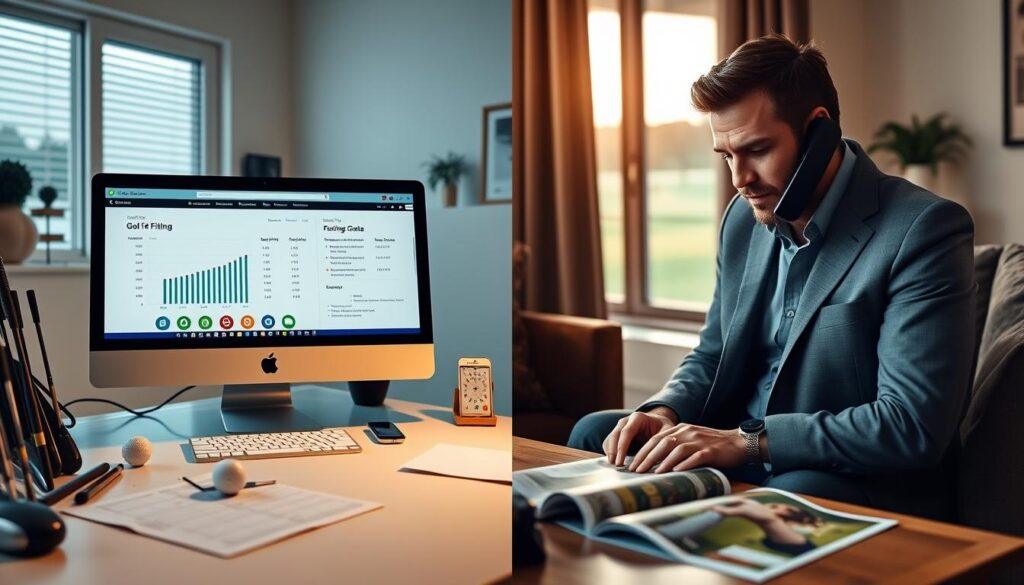
Clicking the “BOOK A FITTING” button is the fast-food drive-thru of appointments. It’s always open, brutally efficient, and requires no small talk. Here’s what that form really wants from you.
You’ll select your fitting type (driver, iron, etc.) from a dropdown menu. This is straightforward. Next, you pick a date and time from a calendar grid. The algorithm shows you what it thinks is available. Pro tip: prime weekend slots often vanish here first.
Then, the personal details: name, email, phone. The “Goals & Current Clubs” field is your secret weapon. Writing “Struggling with a slice, gaming 10-year-old irons” is like giving the chef your allergy list before you order. It lets your fitter prep.
You submit. A confirmation email hits your inbox. You’re done. The entire process takes three minutes and zero human interaction.
The Bespoke Call: Phone Booking
Dialing (412) 787-0292 during store hours is the bespoke tailor’s approach. This is a two-minute conversation that can reshape your entire experience.
A real person answers. You state your desire for a clubfitting. Now, the tactical part begins. You can ask nuanced questions immediately. “Do you have outdoor bays for real ball flight?” is a valid opener, nodding to the data you care about.
You discuss schedule. The human on the line knows the actual calendar—not just the digital facade. A 2-minute call can secure a prime-time slot the algorithm hides, much like knowing the maître d’ gets you the corner table.
You provide the same core info (handedness, goals) but through conversation. You might even get a read on the fitter’s personality. This call is a mini-consultation that builds rapport before you even arrive.
| Channel | Process | Best For | Tactical Edge |
|---|---|---|---|
| Online Booking | Form-based, 24/7 submission. Select type, date, add notes. | Night owls, planners, those who hate phones. | Speed and a written record of your goals for the fitter. |
| Phone Booking | Live call during shop hours. Conversational, immediate Q&A. | Complex schedules, nuanced questions, relationship builders. | Human negotiation for better slots and instant pre-fitting insight. |
So, which to choose? If your schedule is flexible and your questions are simple, the online booking path is your silent, efficient ally. If your calendar is a puzzle or you crave that early insider knowledge, the phone booking route offers a distinct human advantage. Both get you to the same place: a booked fitting. One just might get you a better seat at the table.
Ideal Lead Times and Best Days to Schedule
Booking a clubfitting in Southeastern PA is more than just picking a time. It’s about understanding the supply and demand. Your appointment scheduling strategy can make a big difference. It can turn a simple hour into a life-changing experience.
Think of lead times like a political campaign. Want a Saturday at 10 AM? That’s like launching on Super Tuesday. You need to plan weeks, not days, in advance. For weekend fittings, a three-week lead time is now the norm.
Mid-week afternoons are the soft launch. They have more availability and offer a big advantage.
The shop’s hours are Monday through Saturday, 10 AM to 6 PM. The early and late slots on Saturdays go fast. If you can, book a Tuesday, Wednesday, or Thursday afternoon. You’ll find a calm atmosphere and a focused fitter.
Now, let’s talk about the weather. Many fittings are at a partner country club. Your appointment scheduling must consider the seasons. Booking an outdoor session in late October is risky.
For the best outdoor experience, book from late spring to early fall. But always have a backup plan. A smart booker checks the weather forecast like it’s key intelligence.
So, what’s the best strategy? Treat the studio’s calendar like a precious resource. Gaming the system means being a smart consumer. Book your weekend dates early. Take advantage of mid-week for a premium session. And always check the season for outdoor fittings.
Your swing needs your full attention. Strategic appointment scheduling ensures that. It makes your booking a calculated step towards better golf.
What Info You’ll Provide (handedness, goals, current clubs)
Before you start, there’s a quick but important question. You’ll share three key pieces of information. This turns you from a bystander to an active player in your golfing journey.
This is your pre-flight checklist. We’re looking for facts, not fiction.
First, we need to know if you’re a righty or a lefty. This isn’t just about your swing. It affects the clubs available to you. If you get this wrong, your session ends before it begins.
Next, we want to hear about your goals. Saying “I want to hit it farther” is vague. Your fitter needs specific details.
What does a clear goal look like? Maybe you want to reduce driver spin or improve your 7-iron consistency. Or perhaps you’re fighting a slice.
Be specific about your golfing challenges. Talk about distance, consistency, or fixing a slice. The more specific you are, the better the solution.
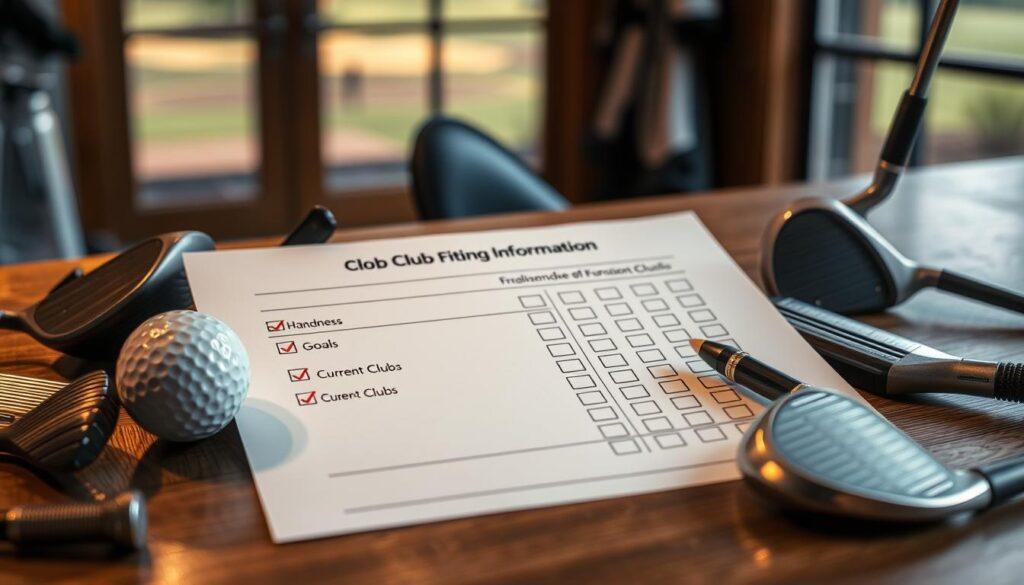
Lastly, bring your current clubs. They’re not trash; they’re your baseline. They help the fitter understand where you are now.
Remember, bring your full set. Even your golf shoes and glove. Swing as you normally do. Your old clubs provide important data for the fitter.
Here’s your briefing:
| Information Type | What to Provide | Why It Matters |
|---|---|---|
| Handedness | A simple “right” or “left” | Filters every club option. It’s the foundation. |
| Primary Goal | A specific, measurable improvement (e.g., “more carry distance,” “straighter ball flight”) | Sets the mission objective. Vague goals yield vague results. |
| Current Clubs | Your entire gamer bag—driver through putter | Establishes the performance baseline. This is your starting line. |
| Supporting Gear | Golf shoes, glove, your typical golf ball | Recreates your authentic swing environment for honest data. |
Coming in with this information is key. It’s the difference between telling a doctor your symptoms or sharing your full medical history. It turns custom clubfitting into a team effort. You become an active participant, not just a subject. This is how breakthroughs happen.
Confirmation, Reminders, and Directions
The confirmation email is key in the custom clubfitting process. It’s like a script for a play. Without it, things can go wrong. Your goal is to move from being just a name to a golfer ready for a change.
Don’t ignore that auto-generated email. It’s like a ticket to a concert. Print it, screenshot it, and save it. It has your date, time, and where you’ll be.
This email is your proof. Losing it is like going to a duel without a gun.
The Reminder: The “Get Your Troops in Position” Alert
24 to 48 hours before, you’ll get a reminder. It’s not a bother. It’s a signal that everything is set. It’s like saying, “We’re ready. Are you?”
This is your last chance to change plans without feeling bad. Just acknowledge it. It’s good for everyone.
The Reconnaissance: Navigating the Two Fronts
Now, we get strategic. Your fitting will be at one of two places. Each needs a different approach.
- The Urban Strip Mall (Robinson Crossroads): It’s at 6563 Steubenville Pike, Pittsburgh, PA 15205. Parking is easy but can be big. Find your spot and the store you’ll be at.
- The Country Club Lane: It’s at 3646 Scotland Road, Chambersburg, PA 17202. It’s a peaceful golf setting. Follow the signs to find your spot.
Arriving late is a big mistake. It makes things tense. You want to arrive calmly, like a hero.
Venue Intel Briefing
| Location | Address | Environment | Key Recon Objective |
|---|---|---|---|
| Robinson Crossroads | 6563 Steubenville Pike, Pittsburgh, PA 15205 | Commercial strip center | Identify specific unit & nearest parking. |
| Chambersburg Country Club | 3646 Scotland Road, Chambersburg, PA 17202 | Suburban country club | Follow club signage to guest parking. |
Follow these steps, and you’ll make scheduling a success. You’ll arrive calm, on time, and ready to improve your swing. Your goal is to make your arrival as smooth as your new driver swing.
Easy “Call the Shop” and Calendar Links
Your dossier is ready. Your strategy is set. The only thing left is your own pace.
The last step is the easiest. For a direct connection, just pick up the phone. A quick phone booking to (412) 787-0292 gets past all the digital clutter. It’s like making a deal with an instructor right away—no forms or menus, just a real talk to book your time.
Or, if you like digital, the “BOOK A FITTING” button is ready for you. It waits for your command. Both ways lead to a place where everything is set up for you.
What’s holding you back? This is your chance to move forward, knowing a perfect fit is waiting for you. Make the phone booking. Click the button. The action is simple, but the outcome is huge.
Call the shop at (412) 787-0292. Or click to book your fitting. Your next step is already better.