

So, you’ve booked the session. Is it a glorified sales pitch, or a forensic audit of your swing? Let’s pull back the curtain.
I’m here to tell you it’s the latter. This isn’t retail. It’s a blend of sports science and tailored craftsmanship that feels more like a visit to a swing therapist.
Think of it as part job interview for your clubs, part biometric screening. We’re not just moving inventory. We’re decoding your swing’s unique dialect to build a foundation for real success.
Forget the myth of the off-the-rack miracle. This personalized analysis is where your game gets its true blueprint for comfort and long-term functionality. The data we gather, handled with care as outlined in our privacy policy, fuels a process that’s about you, not a sales quota.
It’s the smart, only way to build a bag that actually works.
Welcome & Goal Setting Interview
Before we start with the TrackMan, we have a deep conversation. It’s the start of your fitting journey. Think of it as a detailed introduction, not just a casual greeting.
I’m not here to criticize your last bad shot. I’m here to understand it. We’ll talk about your current handicap, your biggest miss, and your main goal. Are you looking to hit the ball farther, hit it straighter, or both? Be honest with us. We can usually tell if you’re not telling the truth.
This is your chance to get us ready. Make sure your information is up to date, confirm your details, and share any concerns. Did you recently change your swing? Are you dealing with an injury? This isn’t just paperwork; it’s important context. It turns raw data into a meaningful story.
We’re setting the stage for your golf story. Are you a range rat aiming for consistency, or a weekend warrior looking to gain yards? I listen like a writer, searching for the flaw we need to fix. This conversation sets the stage for what’s to come.
Common goals often fall into a few main categories:
- Distance Hunters: “I need to carry that bunker.”
- Accuracy Seekers: “My dispersion pattern looks like a shotgun blast.”
- Consistency Cravers: “I have two different swings, and I never know which one will show up.”
This interview is the “why” behind all the “what” we’ll measure with technology. It makes sure we’re not just looking at numbers when we check the launch monitor. We’re reading a story we already know the first chapter of. The story is set. Now, we add the science.
Dynamic Testing with Launch Monitor
You’ve given your stats. Now it’s time to see your swing in action under the digital microscope. Static measurements are just the start. Dynamic testing is where the real action happens.

You’ll hit real golf balls. A GCQuad or TrackMan will watch. It breaks down your swing with the precision of a cardiogram. This is where your “feel” meets its data-driven twin.
That gentle draw you swear you play? We’ll check the spin axis. That “pure” strike that feels so solid? We’ll measure the smash factor. The machine tells it like it is, separating fact from fiction.
It’s not here to judge your swing. It’s here to translate it. Your action speaks in the poetry of instinct. The launch monitor is our Rosetta Stone, decoding launch angle, spin rate, and club path.
Think of it as verification of programming. We use the tech to measure output. Then, we fine-tune based on your unique profile. This isn’t guesswork. It’s engineering.
The session becomes a series of experiments. Each shot is a data point. Tools like the TrackMan or GCQuad test against prescription requirements. They tell us what’s working and what’s not.
You get immediate feedback. A number replaces a feeling. It’s enlightening, and sometimes, a little humbling. But it’s always the truth. Your fitting has now moved from theory into the undeniable world of physics.
Head/Shaft/Aperture Trials and Data Review
This phase is like the ‘Great British Bake Off’ of golf gear, but instead of soggy bottoms, we’re judging spin rates. The dynamic testing gave us the recipe. Now, we start baking with different ingredients.
This is the core activity: the head, shaft, and aperture trials. It’s a systematic, A/B/C/D test of your golfing soul. We swap driver heads with the urgency of a pit crew. We line up a matrix of shafts that would give a piano tuner anxiety. Different irons, different lofts, different feels. This isn’t a guessing game. It’s a hypothesis, and the launch monitor is our peer-reviewed journal.
Here’s where the concept of verification takes over. It’s not about which club feels the coolest. It’s about which combination makes the numbers sing in harmony. Did that fancy, low-spin shaft actually lower your spin? Or did it just lower your confidence? The monitor doesn’t have an ego. It tells the truth.
We use specialized tools to cut through the noise. Enter the shaft optimizer. Think of it as a sophisticated matchmaking service for your swing. It analyzes your tempo, load, and release to narrow the field from hundreds of options down to a handful of truly viable candidates. The shaft optimizer provides the shortlist, but it doesn’t cast the final vote.
That privilege belongs to you and the data, sitting in the review chair together. We scrutinize the numbers like detectives at a crime scene. We’re looking for the smoking gun: the combination where your most athletic swing and the most obedient data shake hands.
- Ball Speed: Is it consistently higher?
- Launch Angle: Is it in the goldilocks zone?
- Spin Rate: Is it optimized for carry and roll?
- Dispersion: Are the misses getting tighter?
This process is one part science fair, one part The Price is Right. The shaft optimizer gives us the objective facts. Your feedback gives us the human context. Together, we move from “maybe this one” to “definitely this one.” The right component isn’t a mystery. It’s a conclusion, verified by the cold, hard math of your own performance.
We’re not just trying on clubs. We’re conducting a verification of performance. Each trial is a data point. Each swing is evidence. By the end, you won’t just know which driver feels good. You’ll know, empirically, which driver is good for you. The shaft optimizer and monitor provide the proof. You provide the swing. The result? A fitting that feels less like a sales pitch and more like a breakthrough.
Lie/Loft, Length, and Swing Weight Tuning
Now that you’ve picked your heads and shafts, it’s time for the fine details. Millimeters and grams make a big difference here. Think of it like getting a suit tailored versus buying one off the rack.
The lie angle on the club is just a starting point. What really matters is how the club hits the ground. Your dynamic lie shows how the club interacts with the ground. It’s like adjusting a concert hall for the best sound.
We find your dynamic lie with simple tools. If your 7-iron is digging in too much, it might be too upright. A slight adjustment can fix this. It’s all about making sure the clubface is square at impact.
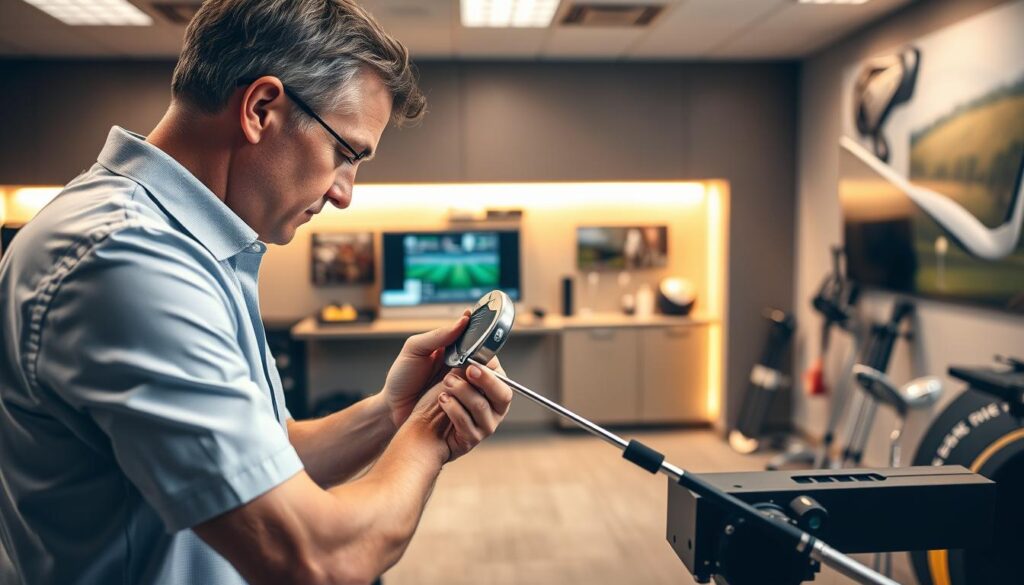
Next, we look at loft. We’re not just looking for distance. We’re fine-tuning it. A small change can make your 7-iron fly just the right distance.
Then, we focus on length and swing weight. Length is about your posture and swing. Swing weight is how the club feels during your swing. We adjust these until the club feels like an extension of you.
| Parameter | Static Measurement | Dynamic Reality | Fine-Tuning Tool |
|---|---|---|---|
| Lie Angle | Number on the hosel (e.g., 62°) | Where the sole contacts turf at impact (dynamic lie) | Impact tape, lie board, bending machine |
| Loft | Stamped loft (e.g., 34° 7-iron) | Actual launch angle and carry distance | Loft/lie machine, launch monitor data |
| Length | Standard length (e.g., 37″ 7-iron) | Comfort, posture, and consistent strike pattern | Cutting/extending shaft, impact location check |
| Swing Weight | A standard like D2 | Perceived heaviness and “head feel” during swing | Lead tape, tip weights, grip weight changes |
This table is more than data. It’s about making the club fit you perfectly. We focus on how the club performs for you. This is the detailed work that makes a good fitting great.
Final Spec Sheet & Next Steps
Getting your fitting done isn’t just about a handshake and a receipt. It’s about getting a detailed document that looks like a technical guide. This is your spec sheet. It’s like the birth certificate and architectural blueprint for your new set, all in one. It shows that your gear has been carefully measured and planned.
Every detail is recorded. From the club model to the shaft brand, flex, and weight. Even the length, lie angle, loft, grip type, and size are noted. This isn’t just a suggestion—it’s your exact prescription. It turns the idea of a “perfect fit” into something you can actually build.
But the work doesn’t stop when you leave. A fitting is like a controlled test environment. The real test is on the golf course. Your body and swing need time to adjust to the new equipment, like breaking in a new jacket.
This is why we schedule a follow-up appointment as part of our fitting process. Did the shaft feel too stiff on a windy day? Was the grip perfect except for a rainy morning? Bring your notes. Your real-world experience is key to improving your fit.
We see this as a team effort. The first fitting gets you close, but the follow-up makes it perfect. It’s the final touch, making sure you trust your gear as much as the numbers on your spec sheet. This ongoing support makes us more than just a place to buy gear—it’s a partnership in performance.
Common Myths Debunked
Now that you know what happens inside a fitting, let’s tackle some myths. Think of this as your intellectual armor for the 19th hole.
Myth one says a golf club fitting is only for good players. This is wrong. A high handicapper’s swing needs more guidance, not less. A proper fitting gives that direction.
Another myth is about the cost. Seeing a fitting as an expense misses the point. It’s the best investment for improving your game. You’re paying to reduce errors, plain and simple.
Lastly, the myth about buying the latest tour model is common. Buying it because a pro uses it is like buying a Formula 1 car for your daily commute. The aim isn’t to play what pros play. It’s to play what the data says you should.
Let data, not dogma, guide your equipment choices. Your scorecard will thank you.