

Let’s start with a confession. Your putting stroke is a lie.
It feels one way in your living room. But it betrays you on the 18th green under pressure. Why? Because feel isn’t real—data is.
Welcome to the era where we stop guessing and start measuring. This is built on a simple principle: reliable performance starts with a forensic examination.
We use the high-speed eye of Quintic technology. It acts as the judge, tracking your ball’s launch for the critical first 16 inches. We pair it with the architectural genius of Capto sensors. They build a 3D biometric map of your stroke’s DNA.
This isn’t a simple tweak. It’s an autopsy of your misses. We’re moving past golf magazine tips and into a lab. Here, “hop and skid” are the enemies. “True roll” is the holy grail.
Think of it as a process that doesn’t just match you to a pretty club. It engineers your motion for pure, predictable roll. Your first step? Admitting you have a problem your eyes can’t see.
Reading Your Stroke (Arc vs. Straight)
Your putting stroke is unique, like your fingerprint. Are you an artist with graceful arcs or an engineer with straight lines? Most golfers choose based on feel or YouTube tips. But, your stroke path is based on your body, not your thoughts.
Your shoulders, eyes, and posture guide your hands. Forcing a straight stroke when your body prefers curves is tough. It leads to tension and inconsistency on the greens.
Modern fitting uses tools like the Capto Gen 3 to understand your mechanics. This sensor breaks down your stroke in detail. It shows your natural stroke pattern and any aim bias.
An aim bias is a directional error in your stroke. It’s like a putting accent. The data shows that even a small misalignment can miss a putt by a lot.
That putt that always goes right? It might not be a misread. It could be your body’s way of compensating for a path that doesn’t match your aim.
You might align the putter face right, but your stroke might pull you off course. Your brain tries to adjust, leading to a fragile motion. This is why some putts feel right but miss, and others feel wrong but go in.
Fitting isn’t about forcing you into an “Arc” or “Straight” category. It’s about finding the right putter for your unique swing. We find out if you’re fighting your natural arc or trying to be something you’re not.
Once we find your aim bias, we can fix it. We adjust the putter to match your stroke. Your stroke becomes a clear statement, not a mix of contradictions. You stop trying to fix something that was never broken.
Head Shapes & Toe‑Hang Explained
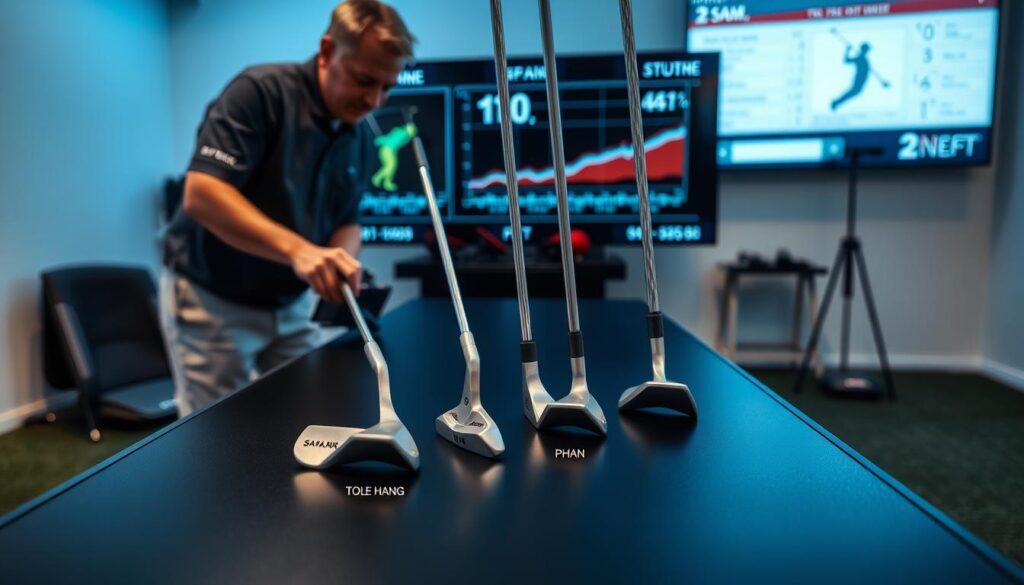
Toe hang isn’t just a dance move; it’s how your putter interacts with the greens. Choosing a putter based on looks alone is like picking a partner for their shoes. It might look good at first but can lead to trouble.
So, what is toe hang? Hold your putter by the shaft. If the head tilts down, it shows its balance point. This is about physics, not yoga.
A putter with a lot of toe hang is made for an arcing path. It opens on the backstroke and closes at impact.
Head shape is also important. There are two main types:
- The Blade: A classic, simple shape with a high toe hang profile. It’s like a sports car—responsive but demanding. It likes to rotate.
- The Mallet: A modern shape with weights on the edges. It’s face-balanced, meaning it points up when hung. It’s like an SUV—stable and forgiving. It prefers a straight path.
Here’s a harsh truth. The putter is often the least custom-fit club. We focus on drivers but pick putters based on looks. This can mess up your aim.
Connecting your stroke data with the putter’s MOI is key. MOI is how much a club resists twisting. A high-MOI mallet is great for a straight stroke. A blade with toe hang is better for an arc.
Forget what’s popular on Tour. Your stroke is unique. The right head shape and toe-hang design match it perfectly. It’s about finding a partner, not just a putter.
Loft/Lie for Roll & Green Speed
The secret to a pure roll isn’t in your hands; it’s in the angles you can’t see.
Picture impact. Your ball doesn’t just roll away. It hops, skids, and—hopefully—settles into a true roll. That skid phase is where puts develop a nasty case of the wobbles. It’s chaotic friction, and it murders consistency.

Loft is the primary suspect. Too much, and you’re launching the ball like a mini pop-up. This creates excessive backspin and a longer, unpredictable skid. Too little loft, and you’re effectively driving the ball into the turf, killing speed and creating bounce.
Lie angle is the accomplice. It dictates how the putter sole rests on the ground. An incorrect lie can cause the toe or heel to be up, subtly twisting the face at impact. This mis-hits your launch conditions and screws with your aim. You’re fighting your equipment.
This is where technology becomes your caddie. Using Quintic high-speed video, we see this launch drama in milliseconds. The data reveals the invisible battle. Our goal? Engineer a “zero skid” launch. We tune your putter’s loft and lie so the ball transitions into pure roll almost instantly.
This tuning is part of a full analysis. We look at every technical specification of your putter to build a complete performance profile.
| Specification | Ideal Purpose | Common Issue if Incorrect |
|---|---|---|
| Loft Angle | Lift ball smoothly onto grass tops for immediate roll. | Excessive skid (too much loft) or turf drag (too little). |
| Lie Angle | Ensure sole sits flat for consistent strike and aim. | Face twisting, directional inconsistency. |
| Length | Promote athletic, repeatable posture. | Compromised setup, inconsistent path. |
| Swing Weight | Provide feel for tempo and distance control. | Poor rhythm, heavy or uncontrollable stroke. |
| MOI (Moment of Inertia) | Increase head stability on off-center hits. | Loss of ball speed and direction on mishits. |
Notice that last entry? MOI is the stability guardian. Once we’ve dialed in your perfect launch conditions with loft and lie, a higher MOI helps preserve them. On those inevitable slight mishits, a high-MOI putter head resists twisting. It keeps the face more stable, so the ball stays close to the launch we engineered.
It’s not magic; it’s mechanics. We’re calibrating the instrument so you can play the song. This meticulous, data-driven approach is core to our fitting philosophy at FS Golf. We turn invisible physics into very visible results on your scorecard.
Grip Size/Shape Impact
Your hands tell the truth, and the grip is their voice. Pick the wrong one, and your swing sounds off. The putter head gets all the attention, but the grip is key. It’s where every decision is made.
Wrong grip size means bad news. Too thin, and your fingers get too active. This leads to twitch and torque, ruining your stroke. Too thick, and you lose feel and control.
The grip shape matters too. It helps your hands find a neutral position. Shapes vary from classic to flat-front, each affecting how you hold the club.
Modern tools like Capto can spot a bad grip. The right putter grip makes your swing smooth. It’s the last step in fine-tuning your game.
Getting a full SAM/Quintic analysis means checking everything. This includes all technical specifications like swing weight and loft. Your hands are in charge. The right grip lets them do their job well.
On‑Course Adoption Tips & Re‑Fit Window
So you have the data. You have the perfect putter. The fitting room applause has faded. Now the real game begins.
Adopting a new stroke profile is a big change. Your old habits are hard to shake. “Practice more” is not enough advice. You need a clear plan to change.
Tools like Capto EZ are very helpful. We call it The Validator. It gives you feedback in real time. It helps you feel the right motion.
Start with simple drills at the beginning. They help you remember your new aim. Have a routine before you putt. It’s about feeling right, not just doing it.
The re-fit window is important. Your body changes, and so does your stroke. We’re not promising a permanent fix. We’re setting a starting point.
Regular check-ups are key. Think of it as an ongoing process. A custom club fitting is just a snapshot. It’s not the whole picture.
Don’t get too comfortable. The best way to keep a low score is with a good putter. But the work to keep it up never stops.