

Your first Full-Bag Fitting should feel like a structured checkup for the whole set, not a mystery sales meeting. The main goal is simple: learn how your current clubs perform, where the gaps are, and which specs may help the set work better from driver through wedges and, often, the putter. A good fitter will not promise a new score or a fixed distance gain. They should give you clearer numbers, cleaner comparisons, and a spec sheet you can use right away or save for later.
Think of the session as part fitting, part equipment audit. You bring the clubs you already play, hit enough shots to build a baseline, then test changes in a controlled way. If you are new to launch-monitor terms or unsure what a lie angle does, that is fine. A first appointment is as much about learning your bag as it is about choosing heads, shafts, grips, or loft settings.
What A Full-Bag Fitting Covers
A complete session looks at every club category you carry so the set works together as one system. That includes the driver, fairway woods or hybrids, irons, wedges, and often the putter. The fitting also reviews gapping, which means checking whether two clubs travel too similar a distance or whether a large gap leaves you guessing on the course. FittingPros describes this as covering the whole bag and evaluating how the clubs fit together in its fitting glossary.
Full-Bag Fitting Baseline Work
Before any testing starts, the fitter usually wants to see your current clubs. That baseline matters because it keeps the session grounded in your real golf, not just a demo-club rack. Your present driver, irons, wedges, and putter show the fitter what you are used to looking at, how the clubs are built, and where performance problems may be coming from.
A Full-Bag Fitting is not only about replacing clubs. Sometimes the useful finding is that a shaft weight is close, a wedge loft gap needs attention, or a grip size is affecting face control. Other times, the numbers may show that a club category is doing its job and does not need to move to the top of your buying list.
Why Gapping Deserves Attention
Gapping is one of the best reasons to book the whole set instead of fitting one club at a time. If your 5-iron and hybrid fly nearly the same number, you may be carrying a duplicate. If your pitching wedge and first specialty wedge are too far apart, you may be forced into half swings too often. The fix may be a loft adjustment, a different club model, or a smarter wedge setup. The key is that the fitter is looking at the bag as a connected set, not as separate purchases.
Full-Bag Fitting Costs And Time
Plan for a serious time block. A full session commonly runs two to three hours, and some facilities ask players to set aside as much as three hours. Published fitting-price guidance places full-bag appointments commonly in the $200 to $500+ range, depending on the facility, club categories tested, brand matrix, and depth of shaft and head options, according to GolfSource fitting guidance.
Ask whether the Full-Bag Fitting fee is separate from any club order, credited toward a purchase, or kept as a stand-alone service charge. Policies vary by shop, and the transparent answer is the useful one. A golfer who understands the fee before arriving can focus on the fitting instead of trying to decode the invoice at the end.
What The Price Usually Reflects
The price is usually tied to time, equipment access, fitter expertise, and how many variables are tested. A deeper session may include more shaft weights, flex profiles, grip options, clubhead styles, and loft or lie adjustments. A shorter or lower-cost version may still be useful, but it may not test as many combinations. Neither format is automatically right or wrong. The better fit is the one that matches your budget, patience, and buying timeline.
How To Budget Without Feeling Pressured
Separate the fitting budget from the club budget before you book. You may leave with recommendations for a driver, irons, wedges, and a putter, but that does not mean everything has to be ordered at once. Many golfers use the spec sheet to prioritize. If the data shows one part of the bag is costing the most consistency, that category may deserve attention first. If several clubs are close, waiting can be the practical call.
What Happens During The Session
The appointment usually starts with a conversation about your game, common misses, playing frequency, physical comfort, and what you want the clubs to do better. Then the fitter gathers static information such as height, wrist-to-floor, hand size, and grip needs. Dynamic testing follows on a launch monitor, where the fitter can review numbers such as launch angle, spin rate, clubhead speed, attack angle, smash factor, and dispersion.
One Variable At A Time
A good testing process changes one main variable at a time. That might mean trying a different shaft flex while keeping the head constant, then testing a different loft, then comparing a different head profile. This keeps the results readable. If the fitter changes head, shaft, length, loft, and grip all at once, it becomes harder to know which change helped or hurt.
The best sessions also include misses. Golfers naturally want to judge a club by the best strike, but a fitter needs to see the pattern. A club that produces one perfect number and five wild misses may not be as useful as a club that keeps the ball in a tighter window. Dispersion matters because golf is played with imperfect swings.
Driver, Irons, Wedges, And Putter
The driver portion often focuses on launch, spin, strike location, face delivery, and playable dispersion. Iron testing usually adds length, lie angle, shaft weight, launch window, and turf interaction. Wedge work can include loft spacing and how the club enters the ground. If the appointment includes the putter, the fitter may look at length, head style, grip, aim tendency, and stroke fit.
- Bring your current clubs, including the ones you do not love.
- Wear golf shoes or the shoes you normally practice in.
- Bring your golf glove and a few balls if you prefer a specific model.
- Arrive warmed up enough to swing, but not worn out.
- Be honest about budget, misses, injuries, and how often you play.
Reading The Recommendation Sheet
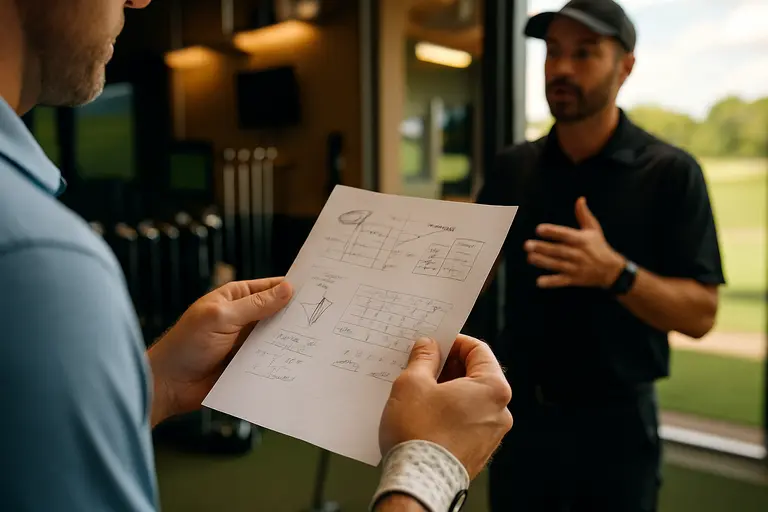
The most useful result is not always a receipt. It is the recommendation sheet. That sheet may list shaft model or shaft type, shaft weight, flex, club length, lie angle, loft, grip size, and sometimes a recommended head style or brand. You should be able to read it after the session and understand why each recommendation was made.
Specs You May See
Length and lie angle often matter in irons because they can influence strike quality and starting direction. Loft matters because it affects distance spacing. Shaft weight can change how you feel the club during the swing. Grip size can affect comfort and how your hands release the club. None of these specs should be treated as magic. They are fitting tools used to match equipment to the way you deliver the club.
No Guaranteed Gain
Be careful with any promise that a fitting will automatically add a set number of yards or remove a set number of strokes. Some golfers see clear improvements in distance, dispersion, launch, or comfort after a proper fit. Others may find that the best recommendation is a smaller adjustment, more practice with the current set, or a phased upgrade plan. The honest value is better information and a club setup that makes sense for your swing today.
Your First Full-Bag Fitting Plan
A first appointment works best when you treat it like a serious practice session with a clear purpose. Know your budget, know your biggest on-course problem, and be ready to hit enough shots for the fitter to see patterns. Do not chase the single longest shot. Watch the clusters, the gaps, and the misses. That is where the fitting usually earns its keep.
Readers who compare practical planning resources across our network, including a related site in the same network like Ambikapur City, will recognize the same idea here: clear expectations save time and prevent rushed decisions. For golf equipment, that means asking direct questions before the booking and leaving with specs you can understand.
- How long should I reserve for the appointment?
- Is the fitting fee credited toward an order or separate?
- Which club categories are included?
- Will I receive a written spec sheet?
- Can I order later if I need time to decide?
If you leave with a cleaner map of your bag, the session has done useful work. You should know where the overlaps are, which clubs fit well enough to keep, and which specs deserve attention when you are ready to buy or adjust. That is a practical first step toward equipment that supports your normal swing instead of fighting it.