

Most golfers treat their equipment like ancient artifacts. We swing, hope for the best, and blame the shank on wind or squirrels.
But what if the real problem isn’t your grip or tempo? What if it’s just numbers?
This is the hidden part of golf improvement. It’s not just about loving your gear. It’s about making it work for you. Think of it like running a marathon in the right shoes.
The lie angle affects how your 7-iron performs. Loft is key for a soft-landing wedge or a low-line missile.
There are other important measurements too. Shaft flex and MOI are like the swing’s timing and the clubhead’s stability. Ignoring them is like ignoring the economy in politics.
Starting your search for the right fit is simple. Just find your proper club length. But there’s more to it. Let’s get real and analytical. Your game needs it.
Learn more about finding the right club length here.
Explaining Each Spec
Think of your golf club as a precision tool. Its lie angle and loft are key to a good swing. If they’re off, you’re fighting against physics. But if they’re right, the game clicks into place.
The lie angle is how your club meets the ground. It’s like a handshake. If it’s too upright, the heel hits first. If it’s too flat, the toe does.
This affects your swing a lot. An upright lie angle makes the ball go left. A flat one makes it go right. The divot shows where the club hits the ground.
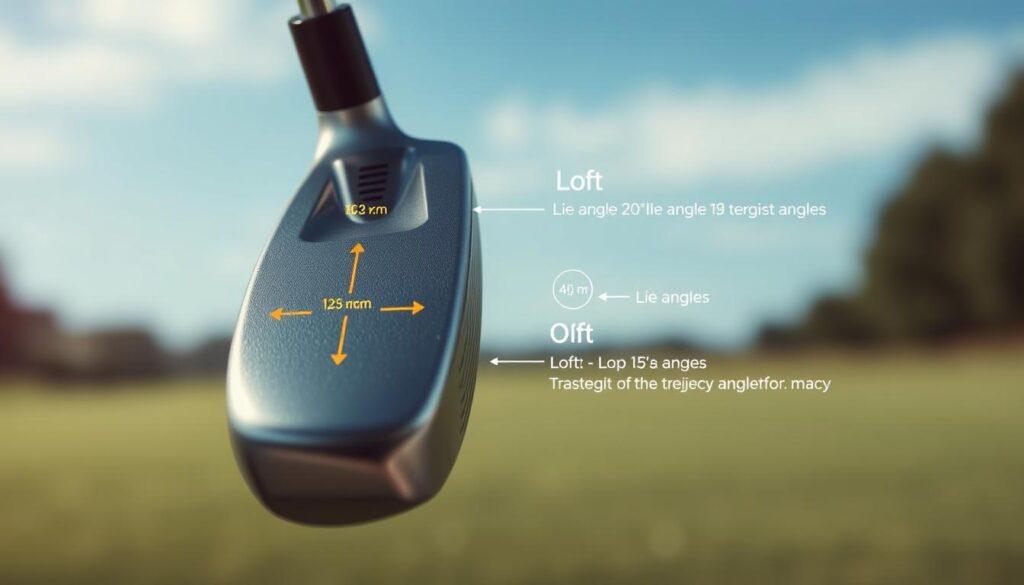
Trying to fix a bad lie angle in your swing is hard. It makes your game unpredictable. It’s not easy to keep doing it round after round.
The loft is about how your ball flies. It’s not about how hard you hit it. It’s about making the ball fly well.
Pros use drivers with 9 degrees of loft. They hit the ball far and high. But amateurs need more loft to get the ball up. It’s smart to use more loft to get the ball airborne.
Manufacturers make clubs with more loft than before. This means your 7-iron might have the same loft as an old 5-iron. Knowing the actual loft is more important than the number on the club.
To learn more about how these angles work in your bag, check out our guide to golf club lofts by degree.
| Club Type | Typical Loft Range | Primary Function | Speed/Launch Profile |
|---|---|---|---|
| Driver | 7° – 13.5° | Maximum distance off tee | High speed, mid-to-high launch |
| Fairway Wood | 13° – 21° | Distance from fairway/rough | High speed, penetrating flight |
| Hybrid | 17° – 27° | Iron replacement, versatility | Easy launch, forgiving |
| Mid-Iron (7-iron) | 30° – 34° | Approach accuracy | Mid launch, controlled spin |
| Sand Wedge | 54° – 58° | High elevation, soft landing | High launch, maximum spin |
| Putter | 2° – 4° | True roll on greens | Low launch, ground interaction |
Look at the table. Your sand wedge has 56 degrees for elevation. Your putter has 3 degrees for a true roll. These numbers solve specific problems on the course.
Knowing your loft means understanding your tools. Using the wrong club is like using the wrong tool for the job. It leads to bad results.
So, your lie angle is your base. Your loft is your height. Master these, and you’re halfway to a great game.
How a Custom Fitting Optimizes Each Parameter
Think “standard” clubs fit anyone? That’s like believing one shoe size fits all feet. The factory’s idea of “standard” is a mathematical ghost—an average of measurements from people who don’t exist. Your swing is your fingerprint. A proper fitting chases that truth.
A fitter uses tools like impact tape and a lie board to find your dynamic lie. This reveals where your club actually meets the turf, not where a static chart says it should. They’ll then bend the hosel, adjusting loft and lie with precision. This creates zero tolerance within your set, turning guesswork into geometry.
This is where MOI enters the conversation. MOI matching ensures every club, from your 4-iron to your pitching wedge, has the same perceived head weight. It builds a rhythm you can trust. Your swing finds a consistent tempo.
The right shaft flex completes the picture. It’s not about stiff or regular labels. It’s about finding the bend profile that loads and unloads in perfect sync with your transition. The correct shaft flex turns the component from a passive tube into an active partner, channeling your energy directly into the ball.
The process is revealing. As detailed in this comprehensive guide to custom fitting, your old swing might feel foreign. The club is now supporting your motion, not fighting it. You’re not adapting to equipment; the equipment is adapting to you.
Optimizing MOI and dialing in your ideal shaft flex removes variables. It lets your athleticism speak. The result isn’t just better specs. It’s a game that feels like your own.